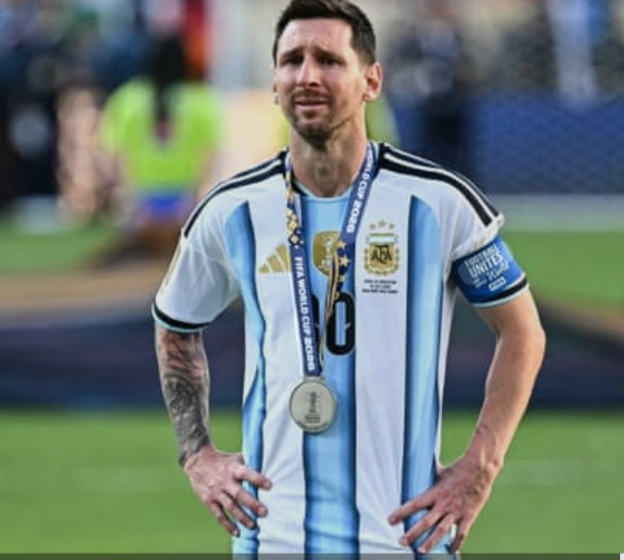
Argentina captain, Lionel Messi, has announced his retirement from international football, bringing an extraordinary 21-year career with the national team to an emotional end.
The 39-year-old football superstar confirmed his decision on Monday, August 31, 2026, through an emotional message shared on Instagram, ending speculation over his future with the Albiceleste.
Messi leaves the Argentina national team as its most-capped player and all-time leading scorer, having made 207 appearances and scored 125 goals for his country. His international career also produced the major trophies that had eluded him for years, including the 2022 FIFA World Cup and back-to-back Copa América titles in 2021 and 2024.
The announcement came just weeks after Messi captained Argentina to the 2026 World Cup final, where they suffered a defeat to Spain. The match ultimately became his final appearance for the national team.
Messi revealed that he had already written the retirement message shortly after that final. According to reports, he drafted it on July 21, two days after Argentina’s defeat to Spain, but decided against publishing it immediately.
In his farewell message, Messi acknowledged that walking away from Argentina was an extremely difficult decision, but said he had reached a point where he believed the time was right.
He explained that he had given everything he could to the national team throughout his long career and wanted to leave knowing he had done his best to make Argentines proud.
Messi said the decision continued to hurt him deeply but that he understood it was necessary.
He also pointed to the emergence of a new generation of Argentine footballers who deserve opportunities with the national team.
The decision marks the end of one of the most remarkable international careers in football history. Messi first represented Argentina’s senior team in 2005 and went on to become the country’s record appearance holder and highest goalscorer.
For years, Messi’s relationship with the Argentina national team was complicated by disappointment in major finals. He suffered defeats in the 2014 World Cup final and the 2015 and 2016 Copa América finals, while criticism from sections of the Argentine public followed some of those setbacks.
He even briefly announced his international retirement in 2016 after Argentina’s Copa América Centenario final defeat to Chile, before reversing the decision and returning to the national team.
His return eventually ushered in the most successful period of his international career.
Messi led Argentina to the 2021 Copa América title, ending the country’s long wait for a major senior international trophy. He followed that achievement by helping Argentina win the 2022 World Cup in Qatar, where he scored seven goals and was named the tournament’s best player.
Argentina subsequently retained continental supremacy by winning the 2024 Copa América, giving Messi three major senior international titles in four years.
His final World Cup campaign came in 2026. Despite being 39, Messi remained an important figure for Argentina and finished the tournament with eight goals. Argentina reached the final but ultimately lost to Spain.
Messi’s retirement announcement also followed the death of his father, Jorge Messi, earlier in August. The loss reportedly caused the Argentina captain to reconsider how much longer he wanted to continue playing international football. Reports indicate that the tragedy strengthened his conviction that it was time to bring his national-team career to an end.
Despite the emotional circumstances surrounding his decision, Messi’s message was also filled with gratitude.
He thanked Argentina’s supporters for their unwavering affection throughout his two decades with the national team and said he would now watch the side from outside rather than from inside the dressing room.
He expressed appreciation to his family, coaches, teammates and officials who accompanied him throughout his journey with Argentina.
Messi also reflected on the extraordinary experiences he shared with his teammates, saying he was proud of the moments they created together and the dreams they eventually turned into reality.
His departure means Argentina must now prepare for life without the player who has been at the centre of the national team for more than two decades.
The transition is expected to provide opportunities for a younger generation of Argentine players, something Messi himself acknowledged in explaining his decision.
At club level, Messi’s playing career is not necessarily over. The forward remains with Inter Miami, where he continues to play in Major League Soccer. His decision concerns international football and marks the end of his Argentina career rather than an announcement of retirement from club football.
Messi’s international legacy is already firmly established. He departs Argentina with 207 appearances, 125 goals, a World Cup title, two Copa América trophies and a record that places him among the most influential players ever to represent his country.
More importantly, his career with Argentina completed a dramatic transformation.
A player once heavily criticised for failing to reproduce his club success on the international stage eventually became the leader who delivered the trophies Argentine supporters had spent years waiting for.
His 2022 World Cup triumph in Qatar, in particular, transformed the narrative surrounding his international career and placed the ultimate prize alongside the other honours he had accumulated during his extraordinary career.
Now, after 21 years, six World Cup appearances and hundreds of matches in Argentina colours, Messi has decided that his journey with the national team has reached its final chapter.
For Argentine football, it is the end of an era.
For Messi, it is a farewell to the shirt he wore throughout one of the greatest international careers the sport has ever seen.