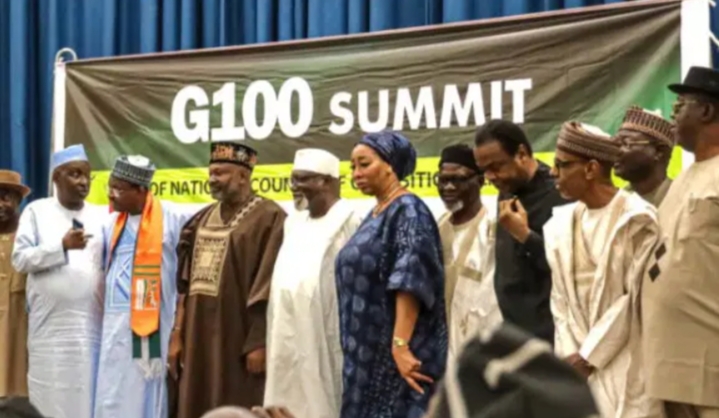
Nigeria’s opposition parties have taken a major step towards building a common political front ahead of the 2027 general election, with six parties agreeing to begin a structured process that could ultimately produce a single presidential candidate.
The development followed a summit of major opposition political parties held on Monday, August 31, at the Shehu Musa Yar’Adua Centre in Abuja and facilitated by the G100, a group working to promote cooperation among opposition forces.
The summit brought together representatives of the African Democratic Congress (ADC), Allied Peoples Movement (APM), Nigeria Democratic Congress (NDC), Peoples Democratic Party (PDP), Peoples Redemption Party (PRP) and Social Democratic Party (SDP).
However, some of the biggest political figures associated with the opposition coalition were conspicuously absent from the meeting.
Among those who did not attend were former Vice President Atiku Abubakar, the presidential candidate of the ADC; Peter Obi, presidential candidate of the NDC; and Oyo State Governor, Seyi Makinde, who is associated with the APM. Their parties, however, were represented by senior officials.
Despite the absence of the three prominent figures, the meeting featured other presidential and vice-presidential candidates, including Social Democratic Party presidential candidate, Adewole Adebayo, Peoples Redemption Party candidate, Donald Duke and APM vice-presidential candidate, Lawal Musa Daura.
The summit focused largely on the challenge of opposition fragmentation and the possibility of establishing a broad political arrangement capable of challenging the ruling All Progressives Congress (APC) in 2027.
G100 Proposes Four-Year Transition Government
One of the most significant proposals presented at the summit was the establishment of what the G100 described as a “Government of National Competence” that would operate for a single four-year transition term.
The proposal was presented by Mallam Salihu Moh. Lukman on behalf of the G100.
According to the framework, the proposed government would be built around four major principles: competence, integrity, national inclusion and fair representation.
The proposal also envisages a National Reset Programme and a legally enforceable Transition Charter that would commit participants to a single four-year term.
Lukman stressed that the arrangement must go beyond political promises and produce binding commitments capable of holding participants accountable.
He argued that Nigeria’s political history is filled with agreements that appeared promising at the beginning but eventually collapsed because there were no effective mechanisms to enforce them.
The G100 therefore wants any agreement reached by the opposition parties to be formally documented, witnessed and backed by consequences for parties or individuals who fail to honour their commitments.
The proposal is part of a broader attempt to create an opposition structure that can survive individual ambitions and party interests ahead of the 2027 election.
2023 Election Remains A Major Lesson
Lukman also used the summit to remind opposition leaders of what he described as the “arithmetical” lesson of the 2023 presidential election.
According to him, opposition votes were divided among several candidates in 2023, allowing the eventual winner to emerge despite the combined strength of rival candidates.
He argued that the opposition should avoid repeating the same mistake in 2027 by allowing multiple candidates to divide votes that could otherwise form a stronger electoral bloc.
The G100 facilitator pointed to previous examples from other countries where opposition parties were able to defeat long-standing ruling parties after overcoming internal divisions.
His central argument was that opposition unity should be approached as a practical electoral calculation rather than simply a moral or ideological project.
The position reflects a growing argument among opposition politicians that a fragmented field could once again make it difficult for any single opposition force to defeat the APC at the presidential level.
Five Working Groups To Be Established
The summit also agreed to establish five Working Groups that will develop key documents for the proposed opposition arrangement.
Each Working Group is expected to include one representative from every participating political party.
The groups are expected to work on a National Covenant for Democratic Renewal, a Single-Term Transition Charter, a National Reform Programme, a Framework for Opposition Unity and a Roadmap to a Common Presidential Candidate.
The working papers are expected to be completed within four weeks and presented at a second opposition summit.
The process is therefore not expected to immediately produce a consensus presidential candidate.
Rather, the parties are first attempting to establish the rules, principles and structures that would guide negotiations over the eventual candidate and broader political arrangement.
Lukman also clarified that the summit was not asking any party to dissolve or merge with another party.
He said no candidate was being asked to withdraw from the 2027 race at the initial meeting, stressing that the immediate objective was to establish the negotiating framework before decisions on individual political positions are made.
House Minority Caucus Backs Opposition Unity
The Minority Caucus of the House of Representatives also backed the initiative.
Leading members of the caucus to the summit, Minority Leader, Fred Agbedi, urged opposition parties to put aside personal ambitions and work towards a collective electoral objective.
Agbedi pointed to the 2015 election, when opposition parties successfully came together under the APC to defeat the then-ruling Peoples Democratic Party (PDP).
He argued that the same principle could be applied in 2027 if opposition parties were willing to subordinate individual ambitions to a broader political objective.
According to him, there would be little value in opposition parties winning millions of votes individually if those votes remained divided and could not translate into victory.
He therefore urged political leaders to learn from the 2023 experience and avoid entering another presidential election as fragmented forces.
Donald Duke Ready To Step Aside
PRP presidential candidate, Donald Duke, also expressed support for the coalition process, indicating that he would be prepared to put his own presidential ambition aside if the participating parties agreed on another candidate.
Duke attributed many of the opposition’s previous difficulties to political ego and warned that parties could not achieve victory if their leaders insisted on pursuing separate ambitions.
He urged opposition politicians to recognise that no individual candidate could successfully defeat the ruling Party alone if the opposition remained divided.
“If we think we can go it all alone, then we will fail,” he said.
His position underlined one of the central issues the proposed coalition will have to resolve: how to persuade presidential contenders to accept a common candidate if the selection process does not favour them.
Party Leaders Endorse Cooperation
Representatives of the participating parties generally expressed support for the coalition-building process, although some warned against internal disagreements.
ADC representative, Usani Uguru Usani, said the opposition should concentrate on its common objective rather than attacking one another.
APM National Chairman, Yusuf Mamman Dantalle, described the summit as a significant development and urged political leaders to place national interests above individual and party considerations.
Representing the Tanimu Turaki-led faction of the PDP, former Niger State Governor and PDP Board of Trustees Secretary, Babangida Aliyu, also backed the process.
Aliyu said the objective of the meeting was not to immediately select candidates or prevent parties from contesting, but to create a foundation that would allow the opposition to determine a common direction when the time comes.
PRP National Chairman, Hakeem Baba-Ahmed, described the meeting as historic and said the participating parties were facing serious challenges, including litigation.
He maintained that the opposition needed to remain united despite those difficulties.
SDP National Chairman, Sadiq Gombe, similarly pledged his Party’s commitment to the coalition process.
The NDC also expressed support for the initiative, with its National Chairman, Moses Cleopas Zuwoghe, describing cooperation among opposition parties as necessary to provide what he called a credible pathway for rescuing the country.
Parties Adopt Joint Communiqué
At the conclusion of the summit, the six political parties adopted a Joint Communiqué formally committing themselves to a structured negotiation process on opposition cooperation ahead of the 2027 election.
They agreed to establish three principal coalition bodies: a Central Leadership Committee, a Publicity and Communication Committee and a Legal Committee.
The Central Leadership Committee is expected to provide political direction and include key representatives of the participating parties.
The Publicity and Communication Committee will coordinate joint messaging, while the Legal Committee will provide legal advice and develop strategies relating to the coalition.
The G100 will remain a facilitator and observer rather than becoming the authority controlling the political parties.
The five Working Groups are also expected to commence work on the proposed reform documents and the roadmap towards a common presidential candidate.
The second summit will subsequently consider the proposals produced by the Working Groups.
The parties also adopted a position calling on the United States Government to make timely and lawful disclosure of non-exempt official records concerning President Bola Ahmed Tinubu that relate to legitimate public interest.
They noted that the demand was connected to an ongoing Freedom of Information Act case in the United States District Court for the District of Columbia, while stressing that the request did not amount to an assumption of wrongdoing or a presumption about the contents of undisclosed records.
Road To 2027 Begins To Take Shape
The Abuja summit represents one of the clearest attempts so far by Nigeria’s opposition parties to move from broad calls for unity to an organised negotiation process ahead of the 2027 presidential election.
However, the absence of Atiku Abubakar, Peter Obi and Seyi Makinde highlights the difficult political negotiations that still lie ahead.
The six parties must ultimately agree not only on a common political programme but also on how a presidential candidate would be selected and how competing ambitions would be managed.
For now, the opposition has agreed to begin with the framework.
Whether the process can survive the competing interests of the parties and their leading politicians will determine whether the latest push for opposition unity becomes another political agreement that collapses before the election or develops into a formidable challenge to the APC in 2027.
The first summit has therefore not produced a single opposition candidate, but it has established a formal mechanism through which the parties can begin negotiating one.
That four-week working period could become the next major stage in Nigeria’s opposition politics as the 2027 general election draws closer.