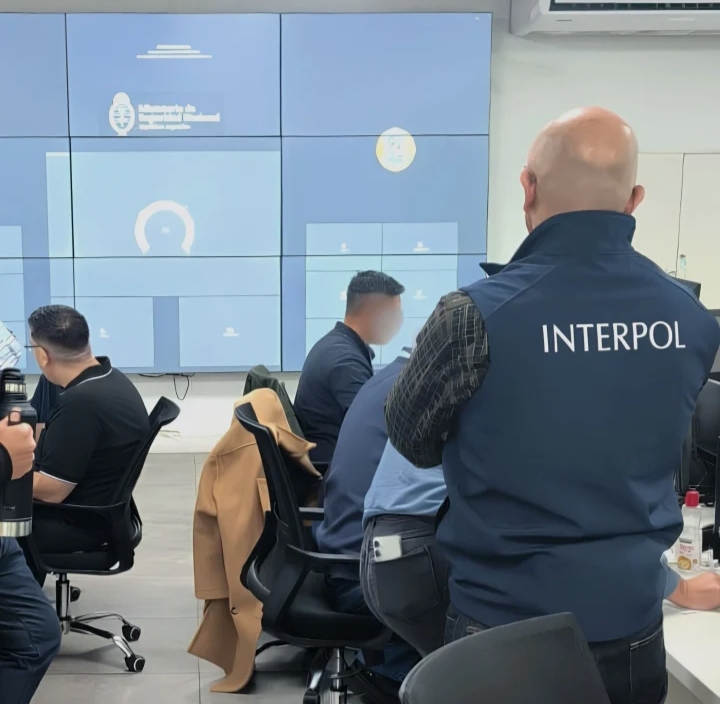
An international law enforcement operation targeting West African organised crime networks, including the Black Axe group, has resulted in the identification of 263 suspects and 58 arrests across 22 countries.
The eight-month operation, coordinated by the International Criminal Police Organisation (INTERPOL), was conducted between November 2025 and June 2026 under the codename Operation Jackal IV. The campaign focused on tracing illicit financial flows, disrupting money-laundering networks, identifying high-value criminal targets, recovering suspected proceeds of crime and supporting investigations, arrests and prosecutions.
INTERPOL announced the results on Tuesday, August 25, saying the operation reflected the growing international reach of criminal networks originating from West Africa.
According to the international police organisation, the operation involved countries across six continents and was designed to tackle criminal groups such as Black Axe and other similar networks accused of involvement in cyber-enabled financial fraud and other serious offences.
The agency said such networks have been linked to a significant proportion of cyber-enabled financial fraud, with criminal schemes including romance scams, cryptocurrency and investment fraud, and business email compromise.
Rather than focusing solely on arrests, Operation Jackal IV placed considerable emphasis on following the money generated by criminal activities. INTERPOL said investigators used cross-border intelligence sharing, financial analysis and operational support to identify suspects and disrupt the infrastructure that allows organised crime groups to move and conceal illicit funds.
Tomonobu Kaya, Director of INTERPOL’s Financial Crime and Anti-Corruption Centre, said international cooperation was critical to weakening criminal organisations.
Kaya said the operation demonstrated the effectiveness of tracking illegal financial flows across borders, arguing that disrupting criminal profits makes it more difficult for organised crime networks to sustain their operations.
196 Suspects Identified In Argentina
One of the major developments occurred in Argentina, where investigators identified 196 individuals allegedly connected to a Crime-as-a-Service network.
INTERPOL said the network was suspected of providing technical and financial support to West African organised crime groups, including website domains and money-laundering assistance. The investigation resulted in 17 arrests.
The case highlights how criminal groups are increasingly able to outsource specialised parts of their operations instead of maintaining all the necessary infrastructure themselves.
INTERPOL said some of the groups examined during the operation were obtaining Crime-as-a-Service from external providers, including providers operating through the dark web. Services could include money laundering and other functions required to facilitate criminal operations.
South Africa Records 39 Arrests
South Africa recorded the largest number of arrests during Operation Jackal IV, with 39 people taken into custody.
Authorities carried out raids at seven locations in Johannesburg linked to a criminal syndicate accused of operating romance and investment scams against retirees in English-speaking countries.
The investigation also uncovered substantial financial activity. Authorities seized approximately $2.67 million and blocked 257 bank accounts believed to be connected to the network.
The operation demonstrated how financial fraud networks can operate across several jurisdictions, with individuals playing different roles in the process of deceiving victims, moving funds and concealing the proceeds.
INTERPOL said its operational support team assisted South African authorities with intelligence and investigative analysis during the crackdown.
Italy Investigation Uncovers Money-Laundering Network
In Italy, investigators identified an individual allegedly connected to a wider European money-laundering network.
According to INTERPOL, the network relied on shell companies, remittance services and cash withdrawals to obscure the origins of criminal proceeds.
Investigators found that a single bank account had been used to move about €845,000 through 560 transactions, involving 20 different financial instruments.
The discovery illustrates the increasingly complex methods used by organised crime groups to move money through legitimate-looking financial channels and make it harder for investigators to establish the original source of funds.
Romania Scam Linked To €143m
Romanian authorities also dismantled a criminal group operating an investment scam through a call centre.
The group allegedly attracted victims with investment opportunities involving stocks and cryptocurrencies before diverting their money into electronic wallets controlled by the perpetrators.
Police arrested 11 people in connection with the investigation.
Authorities seized about €330,000 in cash and cryptocurrency, six properties and several luxury watches. INTERPOL said the wider scam was estimated to have stolen and laundered approximately €143 million globally.
Sextortion Of Minors Emerges As Growing Threat
Beyond traditional financial fraud, Operation Jackal IV also exposed what INTERPOL described as a worrying increase in sextortion targeting minors.
The agency said some victims were as young as 14.
According to investigators, offenders typically make initial contact with young victims through social media and gradually establish a relationship or gain their trust. The criminals then allegedly pressure victims into sharing explicit images or videos.
Once the material has been obtained, the perpetrators threaten to distribute it to the victim’s friends, family members or other contacts unless money is paid.
INTERPOL’s findings indicate that organised crime groups are expanding beyond conventional online fraud and exploiting social media platforms to target vulnerable victims, including children.
Nigeria Among 22 Participating Countries
Nigeria was one of the 22 countries that participated in Operation Jackal IV.
The other participating countries were Austria, Argentina, Australia, Canada, Côte d’Ivoire, France, Germany, Indonesia, Ireland, Italy, Japan, Malaysia, the Netherlands, Portugal, South Africa, Spain, Sweden, Switzerland, the United Arab Emirates, the United Kingdom and the United States.
The countries represented six continents and worked with INTERPOL to exchange intelligence, identify suspects, trace financial transactions and support enforcement activities.
The latest operation follows previous international efforts targeting Black Axe and related West African organised crime networks. INTERPOL has previously described Black Axe and similar groups as having a significant global footprint and links to cyber-enabled financial fraud.
Operation Jackal IV therefore represents another coordinated attempt to attack organised crime not only through arrests but also by disrupting the financial systems and technological services that enable criminal networks to operate internationally.
With 263 suspects identified and 58 arrests recorded, INTERPOL said investigations arising from the operation remain ongoing in several jurisdictions.
The agency’s findings also point to the changing nature of organised crime, with traditional fraud increasingly intersecting with cryptocurrency, online platforms, dark-web services, money laundering and the exploitation of minors.
For law enforcement agencies, the challenge is no longer limited to identifying individual criminals. The broader objective is to dismantle the international networks, financial channels and support services that allow organised crime groups to operate across borders.