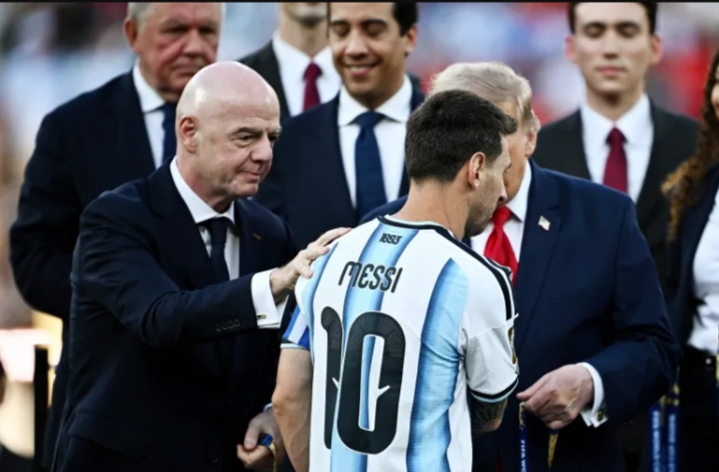
The growing dispute over the leadership of world football has taken another turn after Argentina and Mexico publicly threw their support behind FIFA President, Gianni Infantino, joining a bloc of football associations and continental representatives resisting calls for major changes at the organisation.
The latest developments have widened the divide between Infantino’s supporters and critics following the collapse of a controversial FIFA proposal involving the commercialisation of rights connected to future World Cup competitions.
Argentina’s football association, AFA, and the Mexican Football Federation, FMF, announced their positions this week, with both Associations backing Infantino’s leadership while acknowledging concerns surrounding the abandoned proposal.
Their support came shortly after the Confederation of African Football, CAF, unanimously reaffirmed its backing for the FIFA President, giving Infantino important support as opposition grows in Europe and among some other football bodies.
The dispute has now developed into one of the most serious political confrontations surrounding FIFA in recent years, with football associations increasingly taking different positions over Infantino’s leadership and the direction of the organisation.
Why Argentina and Mexico’s Support Matters
The backing from Argentina and Mexico is significant because both countries are major forces in international football.
Mexico was one of the three co-hosts of the 2026 FIFA World Cup, alongside the United States and Canada. Its football federation therefore occupies an important position within the North and Central American football structure.
The FMF’s decision is particularly notable because it does not completely mirror the position taken by CONCACAF, the Confederation responsible for football in North America, Central America and the Caribbean.
CONCACAF has been among the organisations demanding greater scrutiny of FIFA’s decision-making processes following the controversy surrounding Infantino’s commercial proposal.
The Mexican federation, however, said it would not recognise or support any process organised outside FIFA’s established institutional framework.
The Federation also endorsed Infantino’s call for FIFA’s 211 member associations to continue working through the organisation’s recognised structures.
For Infantino, that declaration provides important political backing from one of the countries that hosted the recently concluded World Cup.
Argentina’s position is equally important.
The Argentine Football Association went beyond the earlier statement issued by South American governing body, CONMEBOL, and directly expressed its support for Infantino.
In a letter to the FIFA President, the AFA praised what it described as a decade of work focused on developing football around the world and strengthening FIFA’s institutional structure.
The Association nevertheless acknowledged that the controversial proposal had created uncertainty and accepted that mistakes had occurred during the process.
Rather than calling for Infantino’s removal, however, the AFA argued that the way forward was to continue working under FIFA’s existing leadership ahead of next year’s presidential Congress.
Africa Gives Infantino Another Major Boost
Infantino also received a major boost from Africa after CAF unanimously reconfirmed its support for the FIFA President.
CAF represents 54 national football associations, making Africa one of the largest voting blocs within FIFA. Its support could therefore prove important as Infantino prepares for the next FIFA presidential election.
CAF President, Patrice Motsepe, has maintained a close working relationship with Infantino, and the unanimous decision means the FIFA President can count on significant backing from the continent.
The African position is particularly relevant because Europe has become increasingly critical of Infantino.
With 54 members, CAF is only one member short of UEFA’s 55 associations. The bloc therefore represents a substantial portion of FIFA’s 211-member voting structure.
The backing does not automatically guarantee Infantino another term, but it strengthens his position ahead of what could become a much more contested presidential race.
Infantino has previously secured two re-elections without facing an opponent. The next election, expected to take place during the FIFA Congress in Morocco in March 2027, could be considerably different.
Norway Calls For Infantino’s Resignation
While Infantino has gained support from Argentina, Mexico and Africa, opposition to his leadership has also become more direct.
Norwegian Football Federation President, Lise Klaveness, called on Infantino to resign on Friday, arguing that he no longer possessed the institutional confidence required to lead FIFA.
Klaveness said the organisation was facing a serious crisis and called for a change in leadership.
Norway’s position represents a significant escalation in the disagreement between FIFA and European football authorities.
UEFA has already maintained its opposition to Infantino’s handling of the commercial rights proposal and has confirmed that its threat to boycott FIFA competitions remains in place.
The European body has been particularly critical of the way the proposal was developed and communicated.
What Started the FIFA Crisis?
The current confrontation was triggered by a FIFA plan to establish a commercial entity that could involve outside investors acquiring interests linked to revenues from major football competitions, including the World Cup.
The proposal generated strong opposition from several continental confederations.
UEFA was among the strongest critics, while CONCACAF and the Asian Football Confederation also expressed serious concerns.
The AFC said the proposal risked undermining the unity and universal nature of the World Cup, while its President, Sheikh Salman bin Ebrahim Al Khalifa, described the lack of consultation as unacceptable.
FIFA eventually abandoned the proposal after the growing backlash.
Infantino said the project had created divisions that were no longer compatible with its original objective and announced that it would not proceed.
However, withdrawing the proposal did not end the dispute.
Instead, the controversy shifted towards questions about governance, consultation and whether FIFA’s President had exercised excessive authority.
FIFA has maintained that the actions surrounding the proposal complied with its regulations and argued that the major problems involved process and communication rather than a breach of governance rules.
More Football Associations Take Different Sides
The dispute has also divided individual national associations.
Croatia recently withdrew its support for Infantino, following similar decisions by England and Albania.
Players’ union FIFPRO has also criticised the FIFA President, describing the handling of the proposal as a serious governance problem and an abuse of presidential authority.
On the other side, several Asian football associations have publicly supported Infantino, including Indonesia, Qatar, Kuwait, Sri Lanka and the Philippines.
This means the emerging battle is no longer simply a dispute between Infantino and UEFA.
Instead, national associations and continental confederations are increasingly taking individual positions, creating competing blocs within FIFA.
What Happens Next?
The next major test is expected to come at the FIFA Congress in Morocco in March 2027, when the organisation is expected to deal with its presidential election.
Infantino will be seeking another term, but the political environment surrounding his candidacy is now far more complicated than during his previous re-elections.
His supporters can point to backing from CAF, Argentina, Mexico and several Asian associations.
His critics, meanwhile, include UEFA and individual national associations such as Norway, Croatia, England and Albania, while FIFPRO has also raised serious concerns.
The withdrawal of the commercial proposal may have prevented an immediate confrontation over FIFA’s business strategy, but it has not resolved the deeper questions about governance and leadership.
The competing positions now emerging across the football world suggest that the disagreement could continue well beyond the controversy that originally triggered it.
For Infantino, the backing from Argentina, Mexico and Africa offers valuable political protection. For his opponents, however, the growing number of calls for institutional reform suggests that the debate over FIFA’s leadership is far from over.
With the next presidential election approaching, the coming months are likely to determine whether the current divisions remain a temporary dispute or develop into a sustained challenge to Infantino’s leadership of world football.