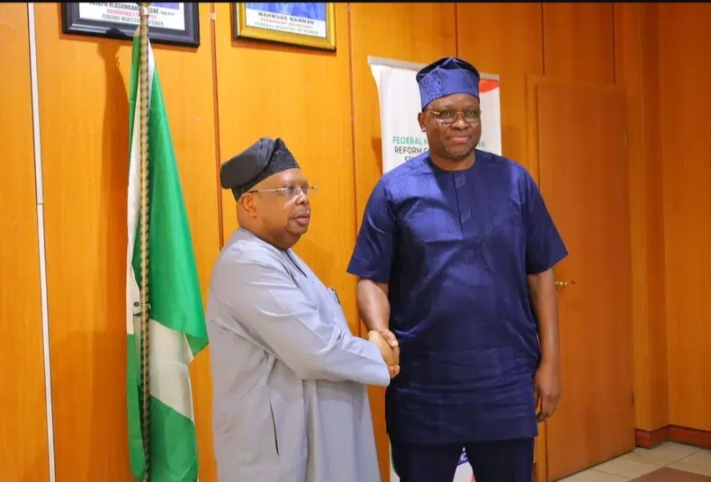
Former Ekiti State Governor, Ayodele Fayose, has officially assumed the position of Chairman of the Governing Board of the Rural Electrification Agency (REA), pledging to deploy his political influence and experience to strengthen the Agency and expand electricity access to underserved communities across Nigeria.
Fayose was formally inaugurated on Friday, August 7, 2026, in Abuja alongside other members of the newly constituted REA governing board by the Minister of Power, Joseph Tegbe.
His inauguration came about two weeks after President Bola Tinubu approved his appointment as Chairman of the Agency. The President had, on July 20, announced 26 appointments across 10 Federal Government agencies and commissions, with Fayose selected to lead the REA board. The appointments took immediate effect.
The new REA leadership is expected to play a major role in the Federal Government’s efforts to increase electricity access, particularly in rural and underserved areas where inadequate power supply continues to affect economic activities, healthcare, education and other essential services.
Fayose, who served as Ekiti State Governor, expressed appreciation to President Tinubu for entrusting him and the other appointees with the responsibility of helping to drive the Government’s electricity agenda.
Speaking after taking the oath of office, the former Governor said his immediate focus would be on providing the political support required to enable the Agency to perform its mandate more effectively.
He said the REA needed strong backing to mobilise the necessary resources and secure funding for projects designed to improve electricity access in communities across the country.
Fayose said his objective was to help move the Agency forward and ensure that Nigerians would see tangible results from its programmes.
He also disclosed that efforts had already begun to mobilise the necessary support for the Agency’s immediate and long-term plans.
According to him, the new board would work quickly to build the partnerships and support required to deliver on its responsibilities.
The former Governor assured Nigerians that the expectations surrounding his appointment and that of the other board members would not be disappointed.
He said the new leadership would give its best toward achieving the electricity-related objectives of the Tinubu administration and ensuring that ordinary Nigerians benefit from Government policies.
Fayose further stressed that the REA’s responsibility should not be viewed simply as a matter of supplying electricity.
He argued that the real measure of the Agency’s impact should be how improved energy access transforms the lives and economic prospects of people living in communities that have historically remained underserved.
The former Governor noted that some of Nigeria’s electricity challenges are particularly pronounced at the grassroots level, making the REA an important institution in efforts to bridge the energy access gap.
He said the Agency’s work must therefore go beyond infrastructure and focus on ensuring that electricity translates into meaningful improvements in the lives and livelihoods of Nigerians.
The new board Chairman’s remarks came against the backdrop of the Federal Government’s broader electricity-sector reforms and implementation of the Electricity Act.
Minister of Power, Joseph Tegbe, who inaugurated the board, said the country needed to change the way it assessed progress in the power sector.
Rather than concentrating predominantly on the volume of electricity generated, Tegbe said the Government would increasingly focus on the number of communities, households and citizens that actually benefit from electricity projects.
The Minister said the central question should no longer be simply how many megawatts are generated, but how many Nigerians are ultimately powered.
He described the Rural Electrification Agency as a strategic institution whose work extends into several areas of national development.
According to Tegbe, reliable electricity can improve education, strengthen healthcare delivery, increase agricultural productivity, support commerce and create opportunities for communities that have traditionally been left behind by economic development.
He said every mini-grid project, solar home system and electrification initiative should be viewed as an investment in human capital and economic inclusion rather than merely an electricity project.
Tegbe also emphasised the importance of ensuring that the benefits of the Federal Government’s power-sector reforms reach communities outside Nigeria’s major urban centres.
He said the REA had an important responsibility to connect national electricity policies with development at the grassroots level, particularly as the Government continues to implement reforms under the Electricity Act.
The Minister urged the newly inaugurated board to maintain high standards of transparency, accountability and prudent management in overseeing the Agency’s affairs.
He also encouraged the board members to explore partnerships with development organisations and private-sector investors to accelerate the deployment of electricity solutions to communities that remain unserved or underserved.
Tegbe said the board should consistently evaluate its decisions against one fundamental consideration: whether those decisions would improve the lives and livelihoods of ordinary Nigerians.
The Minister described the inauguration of the board as another indication of the Tinubu administration’s intention to strengthen governance and strategic oversight across federal institutions.
Meanwhile, REA Managing Director and Chief Executive Officer, Abba Aliyu, expressed appreciation to President Tinubu for the opportunity given to the new board and management team.
Aliyu assured Nigerians that the Agency would continue working to extend electricity access through its rural electrification and off-grid programmes.
Fayose’s appointment had earlier been announced by the Presidency alongside the appointments of Ahmadu Abubakar and Ilyasu Makinta as members and non-executive directors of the REA board. The Wgency’s Director-General, Abba Aliyu, and three previously appointed executive directors also form part of the board structure.
The appointment followed the Federal Government’s broader restructuring of the leadership of several agencies, with 26 individuals appointed to boards and management positions across 10 federal institutions.
For Fayose, the new role represents a return to a prominent federal public position after his tenure as Governor of Ekiti State.
His emergence as REA Chairman has also placed him at the centre of one of the Federal Government’s key development priorities: expanding access to reliable electricity beyond major cities and into rural communities.
The challenge before the new board will now be to translate its mandate into measurable improvements in electricity access, particularly for communities and productive sectors that depend on reliable power for education, healthcare, agriculture, small businesses and local economic development.
With Fayose promising to provide the political backing needed to advance the Agency’s programmes and Tegbe insisting that success must ultimately be measured by the number of Nigerians who benefit, the new REA board begins its tenure under pressure to deliver visible results.
The inauguration therefore marks more than the formal commencement of Fayose’s tenure. It places the former Ekiti Governor and his fellow board members in charge of providing strategic oversight for an Agency whose work is central to the Federal Government’s ambition of making electricity access more inclusive across Nigeria.