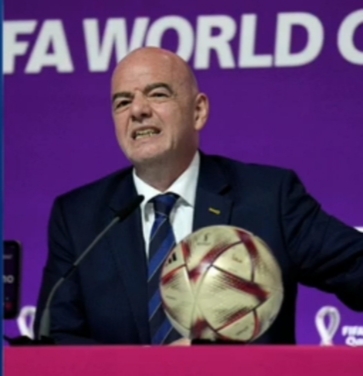
FIFA President, Gianni Infantino has issued a public apology over the controversial proposal to sell a stake in the governing body’s flagship competitions, including the FIFA World Cup, but has made it clear that he has no intention of stepping down despite mounting criticism from football leaders, politicians and former players.
The apology comes after days of intense backlash over a now-withdrawn plan to establish a new commercial structure that would have allowed private investors to acquire a financial stake in FIFA competitions. The proposal triggered widespread opposition across global football, with critics arguing that such a move threatened the independence and long-term integrity of the world’s biggest sporting event.
Following emergency meetings in Rabat, Morocco, FIFA released a joint letter signed by Infantino and FIFA Secretary General, Mattias Grafstrom. In the statement, the organisation admitted that mistakes had been made during the handling of the proposal and acknowledged that football stakeholders should have been more closely involved before the plan became public.
According to the letter, FIFA accepted responsibility for the communication failures surrounding the proposed FIFA Forward Enterprise (FFE), the commercial vehicle that would have overseen the investment project.
The governing body admitted that its member associations and the FIFA Council felt excluded from the decision-making process, adding that the proposal should have been handled differently from the outset.
FIFA also acknowledged that additional errors occurred after details of the proposal were leaked to the media, intensifying the controversy and fuelling divisions within international football.
“We sincerely apologise for these errors and commit to them not happening again,” the letter stated, while confirming that an internal review of the entire process will be carried out before findings are presented to the FIFA Council at its next scheduled meeting.
World Cup Investment Plan Officially Withdrawn
FIFA confirmed that the proposal has now been completely abandoned.
The organisation stressed that the investment scheme would only have proceeded with the approval of both the FIFA Council and the 211 member associations, but insisted that the project is no longer under consideration.
Despite withdrawing the proposal, FIFA maintained that all actions taken during the planning process complied with its existing governance rules and regulatory framework.
The governing body also vowed to defend its reputation against what it described as attacks on its integrity and governance, signalling that it intends to respond firmly to allegations questioning its decision-making processes.
The letter further reaffirmed the support of FIFA’s management leadership for Infantino, stating that members present at the emergency meeting backed his continued leadership while also pledging support for Secretary General, Mattias Grafstrom.
Pressure on Infantino Continues to Grow
Although FIFA has apologised, the controversy appears far from over.
Several influential football figures and political leaders have openly questioned Infantino’s leadership following the failed proposal.
One of the most significant voices to join the growing criticism is Portuguese football legend, Luis Figo.
The former Barcelona, Real Madrid and Portugal star accused Infantino of damaging the reputation of the FIFA presidency, arguing that the office has been diminished under his leadership.
Figo’s intervention carries considerable weight because few former elite footballers have publicly criticised the FIFA President during the crisis. His comments make him one of the highest-profile football personalities to call for Infantino’s departure.
Political pressure has also intensified.
Canadian Prime Minister, Mark Carney said he has lost confidence in the FIFA President, arguing that major governance decisions should never be concealed from senior officials and board members.
Canada, alongside the United States and Mexico, co-hosted the recently concluded FIFA World Cup, making Carney’s criticism particularly notable.
UEFA Expected to Shape the Next Phase
Attention is now turning to UEFA, Europe’s football governing body, which has emerged as one of the strongest critics of the abandoned investment proposal.
Football analysts believe UEFA’s response to FIFA’s apology could significantly influence how the controversy develops over the coming months.
Other continental football bodies, including the Asian Football Confederation (AFC) and the Confederation of North, Central America and Caribbean Association Football (CONCACAF), have also expressed reservations about the failed proposal.
However, no formal vote to remove Infantino has yet been initiated.
Possible Routes to Leadership Change
While calls for Infantino’s resignation continue, removing a sitting FIFA president is neither simple nor immediate.
Several constitutional pathways exist.
One possibility would involve an emergency vote of no confidence by the FIFA Council.
Another option would require an extraordinary FIFA Congress where member associations could vote on the President’s future.
An ethics investigation could also potentially create another route, although no official ethics proceedings have been announced.
If none of those mechanisms are activated, attention will shift to FIFA’s next presidential election.
A crucial milestone in that process is 18 November, the deadline for presidential candidates to officially declare their intention to contest the election.
At present, no challenger has formally entered the race.
Election Numbers Could Decide the Outcome
Should the dispute ultimately be settled through an election, candidates will need broad international backing.
FIFA’s president is elected by votes from its 211 member associations, with a candidate requiring more than half of the total votes to secure victory in a two-candidate contest.
That voting system places enormous importance on support from the six continental confederations.
UEFA represents 55 member associations, while the Confederation of African Football (CAF) accounts for 54 votes.
The Asian Football Confederation (AFC) has 46 members, CONCACAF controls 35 votes, the Oceania Football Confederation (OFC) has 11 members, and South America’s CONMEBOL represents 10 associations.
Securing alliances across those regions is expected to become central to any campaign against the incumbent FIFA president.
Governance Debate Far From Over
Although FIFA insists the investment proposal has been permanently withdrawn, the controversy has reignited wider debates about transparency, governance and accountability within world football.
Critics argue that decisions affecting football’s most valuable competitions should involve extensive consultation with member associations before reaching advanced planning stages.
Supporters of governance reform believe the current dispute could lead to stricter oversight of future commercial initiatives and stronger safeguards for FIFA’s decision-making processes.
For now, Infantino remains in office, backed publicly by senior FIFA executives, but under growing scrutiny from influential football stakeholders around the world.
With the November nomination deadline approaching and pressure continuing to build across international football, the coming months are expected to determine whether the FIFA President successfully weathers one of the biggest governance crises of his tenure or faces a serious electoral challenge for the first time in years.