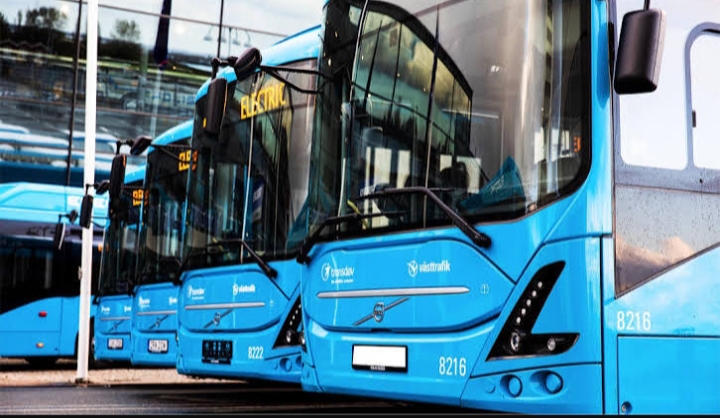
The Federal Government has launched a 100-bus electric mass transit programme designed to reduce the financial pressure of daily transportation on federal civil servants and improve their safety, punctuality and productivity.
The initiative, unveiled in Abuja on Wednesday, August 26, 2026, is part of the Renewed Hope Mass Transit Programme and is expected to provide dedicated transportation for government workers along designated routes.
However, only 37 of the 100 buses have so far been delivered, with the first batch formally commissioned at Eagle Square, Abuja. The remaining buses are expected to be deployed in subsequent phases, with reports indicating that the full complement is expected by December 2026.
The Head of the Civil Service of the Federation, Mrs. Didi Esther Walson-Jack, presided over the commissioning shortly before the end of her tenure. She described the project as a significant intervention in the welfare of federal civil servants and a fitting way to conclude her time in office.
According to Walson-Jack, the issue of transportation goes beyond simply moving workers between their homes and offices. She explained that the cost and conditions of daily commuting can have direct consequences for workers’ finances, safety, punctuality and ability to perform effectively at work.
She said the new buses were therefore intended to provide civil servants with a safer, more affordable and dependable means of getting to and from their workplaces.
The outgoing Head of Service described the project as a personal milestone, saying she was pleased that an initiative she had worked toward had become operational just before her departure from office.
Walson-Jack is expected to leave the position of Head of the Civil Service of the Federation on Thursday, August 27, making the bus commissioning one of her final major activities in the role. Several reports described the intervention as her “parting gift” to federal civil servants.
She said the acquisition of the buses was made possible through the Renewed Hope Infrastructure Development Fund, linking the project to President Bola Tinubu’s broader Renewed Hope Agenda.
The Head of Service also pointed to other measures introduced by the Federal Government, including the review of the national minimum wage, wage awards following the removal of the petrol subsidy, digitalisation of government services and renewed attention to issues such as pensions, promotions, employee compensation and health insurance.
Her argument was that government reforms should produce benefits that workers can experience in their everyday lives rather than remain limited to policy announcements.
The electric bus programme is expected to begin with a pilot phase along selected routes in the Federal Capital Territory. The routes are expected to connect major residential areas with the Federal Secretariat and other government offices.
Officials said the pilot phase would allow the government to assess the operation of the buses before expanding the scheme more broadly across the Federal Civil Service.
The buses are also expected to serve federal workers beyond Abuja as the programme progresses. Walson-Jack said plans included deployment to Federal Secretariats in other parts of the country. A Special Purpose Vehicle has also reportedly been established to oversee the management, maintenance and long-term sustainability of the buses.
The Minister of State for Industry, Senator John Owan Enoh, described the programme as more than a transportation initiative.
According to Enoh, the project combines workers’ welfare with productivity, technology, environmental considerations and the Federal Government’s broader ambition to strengthen Nigeria’s automotive industry.
He said the 100 buses, once fully deployed, would provide dedicated mass transportation for federal civil servants and reduce the amount workers spend on commuting.
Enoh said each of the buses could carry as many as 200 passengers and travel at least 200 kilometres on a full charge. He argued that the figures demonstrated the potential of electric mobility to provide large-scale public transportation while reducing dependence on conventional fuel-powered vehicles.
The Minister also positioned the project within the government’s industrialisation strategy.
He said Nigeria should not merely import and operate electric vehicles but should gradually develop the capacity to manufacture vehicles and critical components locally. According to him, areas such as battery technology, charging infrastructure, power electronics and modern vehicle systems would be important to the development of a sustainable electric mobility ecosystem.
Enoh maintained that increased local production could create employment opportunities, deepen industrial capacity and support the development of Nigeria’s automotive manufacturing sector.
The National Automotive Design and Development Council, NADDC, has also been involved in the project. Officials said the buses were developed in line with the objectives of Nigeria’s national automotive policy.
NADDC Director-General, Joseph Osanipin, described the initial deployment as the beginning of a phased rollout, with the complete 100-bus fleet expected to be deployed by December 2026.
The Federal Government has also urged beneficiaries to take responsibility for the proper use and preservation of the buses.
Walson-Jack appealed to civil servants to regard the vehicles as valuable public assets, stressing that their long-term usefulness would depend partly on responsible use and proper maintenance.
The government’s decision to introduce electric buses comes against the backdrop of continued pressure on household finances and transportation costs across Nigeria. For civil servants who commute daily, transport expenses can represent a substantial portion of monthly income, particularly for workers travelling long distances to government offices.
The new scheme is consequently being presented not simply as a mobility project but as a welfare measure aimed at reducing one of the recurring expenses faced by government employees.
Beyond reducing transport costs, officials believe more reliable commuting arrangements could improve punctuality and productivity within the Federal Civil Service. Workers who spend less time dealing with unpredictable transport conditions may be better positioned to resume duties on time and remain productive during working hours.
The environmental aspect of the programme is another consideration. Electric buses do not rely on conventional petrol or diesel engines for propulsion, aligning the initiative with the growing global shift toward cleaner forms of transportation.
For the Federal Government, however, the immediate priority appears to be ensuring that the buses deliver tangible relief to workers.
The first 37 buses now represent the operational starting point of the programme, while the remaining vehicles are expected to expand the reach of the initiative.
The success of the project will ultimately depend on factors including route planning, charging infrastructure, maintenance, availability, security and proper management. Effective implementation will also determine whether the programme can provide the reliable and affordable service promised by the government.
As Walson-Jack prepares to leave office, the electric mass transit programme has emerged as one of the final initiatives associated with her tenure as Head of Service.
The Federal Government is now expected to focus on putting the buses into regular operation, completing the deployment of the remaining fleet and determining how the model can be extended to more federal workers across Nigeria.
With 37 buses already delivered out of the planned 100, the government has begun what officials describe as a phased effort to make daily commuting less expensive, safer and more dependable for federal civil servants.
The initiative also gives the administration an opportunity to test electric mass transit on a larger scale while pursuing its stated objectives of improving workers’ welfare, supporting local industry and expanding Nigeria’s transition toward cleaner transportation.