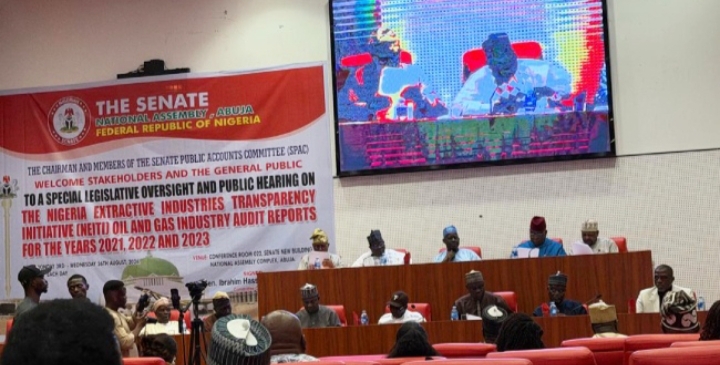
The Federal Ministry of Finance has come under scrutiny over unresolved financial issues contained in the Nigeria Extractive Industries Transparency Initiative’s audit of the oil and gas sector, with officials pointing to difficulties in obtaining records from key petroleum agencies, particularly the Nigerian National Petroleum Company Limited.
The disclosure was made on Thursday, August 13, 2026, when the Ministry appeared before the Senate Committee on Public Accounts to respond to observations contained in NEITI’s 2021–2023 audit findings. The hearing focused on several transactions involving billions of dollars and naira, including a $3 billion financing arrangement, $722.6 million in Nigeria LNG Limited-related payments, refinery expenditure and overhead costs incurred by the National Petroleum Investment Management Services.
The Ministry of Finance said it had not been able to provide complete explanations on some of the matters because it was not directly responsible for all the transactions and had faced difficulties obtaining supporting documents from agencies involved in the petroleum sector.
Permanent Secretary of the Ministry, Raymond Omachi, told the lawmakers that the absence of records from relevant agencies had complicated efforts to reconcile the issues identified by the extractive industries watchdog.
According to him, the Ministry’s difficulty was particularly linked to agencies such as the NNPCL and the Nigerian Upstream Regulatory Commission, which hold records relating to some of the transactions under review.
Omachi explained that the Ministry had engaged an external auditing firm, Arthur Andersen LLP, to undertake a forensic examination of the transactions and help reconcile outstanding questions.
However, the Senate committee expressed concern over the delay in concluding the exercise, especially as the period initially approved for the forensic audit had already been extended twice.
The committee noted that an audit initially expected to take six months had been extended to one year, raising questions about why several issues remained unresolved.
One of the major matters before the committee was a $3 billion pre-export financing loan obtained in 2012. The facility was reportedly connected to efforts to finance subsidy payments, with repayment expected through deductions from monthly Federation revenue proceeds under the pre-export financing and Project Eagle arrangements.
NEITI raised concerns over how the recovery of the facility was handled and whether the relevant deductions and repayments could be adequately traced through available records.
The issue has attracted particular attention because of the substantial amount involved and the need to establish how public revenues were applied in settling the financing arrangement.
Another major issue concerns $722.6 million in dividends and interest paid by Nigeria LNG Limited to NNPC in 2021 on behalf of the Federation.
NEITI questioned the treatment of the funds, stating that they were not remitted to the Federation or adequately accounted for based on the information available to the auditors.
The Senate hearing therefore sought clarification on the movement of the money and the responsibility of the agencies involved in receiving, accounting for and remitting the funds.
The issues form part of broader concerns raised by NEITI about transparency, revenue management and accountability within Nigeria’s oil and gas industry. NEITI maintains publicly available audit records covering different periods, including the 2021, 2022 and 2023 oil and gas audits.
The audit findings also drew attention to Nigeria’s refineries. The Ministry was unable to immediately provide a comprehensive explanation regarding NEITI’s observation that none of the country’s refineries was operational in 2021, despite approximately ₦200 billion reportedly being spent on refinery-related activities.
The question of refinery expenditure remains significant because of the enormous public resources historically committed to maintaining, rehabilitating and upgrading Nigeria’s state-owned refining facilities.
The committee also examined about $221.283 million in overhead costs attributed to the National Petroleum Investment Management Services in 2021.
NAPIMS, which manages major upstream petroleum investment responsibilities on behalf of NNPC, has been involved in several financial transactions connected with Nigeria’s joint-venture and upstream petroleum operations. NEITI’s audit process is designed to examine payments, government receipts, production information and related financial records across the extractive sector.
The Finance Ministry’s position at the hearing was that resolving the queries required the participation of the agencies that either conducted the transactions or maintained the underlying records.
Omachi told the lawmakers that the Ministry was experiencing difficulties getting the affected institutions to provide the information required to close the outstanding issues.
He also acknowledged the authority of the Senate committee to compel the agencies to appear and provide explanations.
The Permanent Secretary urged the committee to bring the relevant agencies together so that the outstanding matters could be addressed collectively.
In response, the committee Chairman, Senator Ibrahim Dankwanbo, directed the Finance Ministry to facilitate a meeting involving the Ministry, NNPCL, NUPRC and any other agency considered relevant to the unresolved transactions.
Dankwanbo stressed that the issues should not be treated as routine administrative matters because of the international attention surrounding Nigeria’s implementation of transparency and accountability standards in the extractive sector.
He said resolving the questions was important not only for the Senate but also for Nigeria’s reputation and its dealings with the international community.
The Chairman therefore instructed the Permanent Secretary to review the Ministry’s internal report and coordinate a meeting where all the agencies could provide the records and explanations required by the committee.
The Senate’s intervention comes as Nigeria continues preparations around its participation in the global Extractive Industries Transparency Initiative process. NEITI has continued to publish sector audits and supporting documents covering petroleum production, government receipts, company payments and other financial activities.
NEITI’s published materials also show the breadth of financial arrangements within Nigeria’s petroleum sector, including alternative financing arrangements where future petroleum production or revenues may be used to secure funding. Its audit documentation highlights the importance of tracing such arrangements from financing through repayment and revenue allocation.
The latest Senate hearing has consequently placed renewed focus on the ability of Government agencies to maintain and produce complete records for major petroleum-sector transactions.
For the Finance Ministry, the immediate challenge is to obtain the outstanding documentation from the responsible agencies and reconcile the figures with NEITI’s observations.
For the Senate committee, the priority is to establish where responsibility lies for the unresolved transactions and determine whether the funds involved were properly applied, accounted for and remitted to the Federation.
The committee is expected to continue examining the audit findings as the affected agencies provide further explanations and supporting documents.
Until the relevant records are produced and reconciled, questions surrounding the $3 billion financing arrangement, the $722.6 million NLNG-related payment, refinery expenditure and the NAPIMS overhead costs will remain among the key accountability issues arising from the NEITI audit.
The developments underline the continuing importance of transparent financial reporting in Nigeria’s petroleum industry, where large-scale transactions directly affect Government revenue and the resources available to the Federation.
The Senate has therefore made clear that the outstanding queries must be resolved, with the committee insisting that the Finance Ministry and the petroleum agencies work together to provide the records needed to establish the full picture behind the transactions.