President Bola Ahmed Tinubu has assured petroleum workers that Nigeria’s Government-owned refineries will return to sustainable operations, insisting that the facilities must not only restart but also become commercially viable and beneficial to the Nigerian economy.
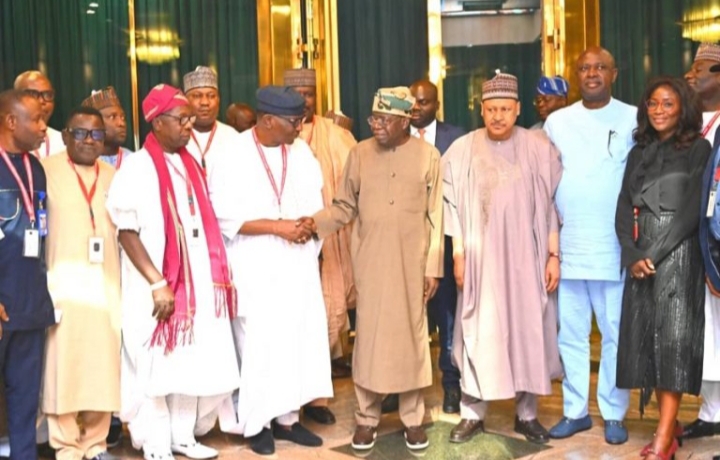
Tinubu gave the assurance on Thursday, August 13, 2026, when he received the newly elected leadership of the Nigeria Union of Petroleum and Natural Gas Workers (NUPENG), led by its Executive President, Comrade Salimon Akanni Oladiti, at the State House in Abuja.
The President said his administration had taken responsibility for the condition of the country’s refineries and would not shift the blame to previous Governments.
According to Tinubu, the objective was not simply to see the refineries producing smoke or operating temporarily, but to establish facilities capable of generating sustainable economic value.
“The refineries that you mentioned is going to come back to work,” the President said, explaining that his administration was undertaking what he described as a fundamental structural and economic reset.
He stressed that visible activity at a refinery should not automatically be interpreted as success, arguing that the ultimate test should be whether the facility can operate profitably and deliver the value for which it was established.
Tinubu said he had accepted both the assets and liabilities inherited from previous administrations, adding that fixing the refineries was now his responsibility as President.
“I’ve accepted the asset and liability of my predecessors, no matter what has happened in the years past, it’s my responsibility now as the President to fix, make it work for the largest common value of our population,” he said.
The President’s comments come amid years of Government efforts to rehabilitate Nigeria’s state-owned refining facilities and reduce the country’s dependence on imported petroleum products.
Nigeria has historically struggled to maintain consistent operations at its Government-owned refineries, despite repeated rehabilitation programmes. The issue has remained central to debates over energy security, fuel supply and the economic consequences of importing refined petroleum products.
Tinubu also used the meeting to defend his administration’s decision to remove petrol subsidy, recalling that he had informed labour leaders before the 2023 presidential election that the policy would be implemented despite the possibility of resistance.
He described NUPENG as an important partner in the Government’s economic reform programme and commended the Union for its cooperation with successive administrations.
The President said the subsidy removal had strengthened the financial capacity of the Federal Government, states and local governments, arguing that increased government revenue had helped public institutions meet salary obligations and finance infrastructure.
Tinubu said his administration would soon publish details of how resources generated following the subsidy removal had been utilised.
He rejected arguments that the policy had produced no benefit for ordinary Nigerians, pointing to the regular payment of salaries across the three levels of government and the wider economic activities generated by public spending.
The President also cited major road projects as evidence of increased Government capacity to finance long-term infrastructure. Among the projects he mentioned were the Lagos-Ibadan, Abuja-Kaduna and Abuja-Kano roads, as well as the Sokoto-Badagry highway.
According to him, the projects were designed to improve connectivity, strengthen economic activity and enhance the safety of Nigerians.
NUPENG’s leadership also praised the administration for its road construction and rehabilitation projects, particularly because of their impact on petroleum tanker drivers.
Oladiti told the President that better roads were directly connected to the safety and welfare of Union members who spend long periods transporting petroleum products across the country.
He specifically highlighted the ongoing Lagos-Calabar Coastal Highway project and the Sokoto-Badagry Superhighway, describing the scale of the projects as significant developments for the country.
The NUPENG President said improved roads would help reduce tanker accidents, petroleum spillages, fatalities and the stress experienced by drivers.
He also appealed to Tinubu to address the issue of casualisation in Nigeria’s upstream oil and gas industry.
Oladiti said NUPENG and the Petroleum and Natural Gas Senior Staff Association of Nigeria (PENGASSAN) had continued to tolerate the situation because of the strategic importance of the petroleum industry and the potentially serious economic consequences of industrial action.
He said the Union had engaged some companies over the matter but had yet to achieve the desired outcome.
Oladiti therefore urged the President to use his office to end what he described as an unhealthy employment practice in the sector.
Another major issue raised by NUPENG was the condition of petroleum depots across the country.
While commending the Federal Government’s efforts to revive the Warri and Port Harcourt refineries through partnerships involving Chinese firms, the union leader called for similar attention to the Nigerian Pipelines and Storage Company depots.
He argued that reviving the depots would complement refinery rehabilitation and strengthen the distribution network for petroleum products.
Oladiti suggested that some of the facilities could be handed over to private investors under equity arrangements to improve their management and operational efficiency.
The Union also appealed to the President to ensure that the Supreme Court judgment granting financial autonomy to local governments was effectively implemented by state governments, describing grassroots development as an important component of national progress.
Tinubu, meanwhile, urged NUPENG to continue its cooperation with the Federal Government, particularly in protecting democracy and supporting economic reforms.
The President also addressed the introduction of Compressed Natural Gas (CNG), which his administration has promoted as a cheaper alternative to petrol for transportation.
While acknowledging the potential benefits of CNG, Tinubu expressed concern that reductions in operating costs were not reaching commuters quickly enough.
He appealed to transport operators to pass the savings from CNG conversion and usage to passengers rather than retaining the benefits entirely within their businesses.
The President said the impact of the CNG initiative should spread across the transport chain and eventually provide relief for ordinary Nigerians.
The meeting also featured the presentation of the Grand Patron of NUPENG award to Tinubu in recognition of his relationship with petroleum and natural gas workers.
The award underscored the Union’s stated commitment to maintaining dialogue with the Federal Government despite disagreements over labour and economic policies.
Minister of Information and National Orientation, Mohammed Idris, who attended the meeting, described the engagement between the Government and labour as evidence of a shift towards dialogue.
Idris said the traditional pattern of confrontation between Government and organised labour was gradually giving way to greater cooperation.
For Tinubu, however, the central message from the meeting was his commitment to making Nigeria’s refineries economically viable.
His assurance that the facilities will return to work places renewed attention on the Government’s efforts to restore domestic refining capacity and reduce reliance on imported petroleum products.
The President maintained that the goal must go beyond restarting the plants temporarily. For the refineries to justify continued public investment, he said, they must operate sustainably, become profitable and deliver measurable value to Nigerians.
NUPENG’s requests, meanwhile, placed broader issues surrounding Nigeria’s petroleum industry on the table, including workers’ rights, depot rehabilitation, road safety, local government autonomy, refinery operations and the benefits of CNG.
The Union’s engagement with the President therefore reflects the continuing importance of organised labour in shaping policies affecting Nigeria’s oil and gas sector, which remains central to the country’s economy.