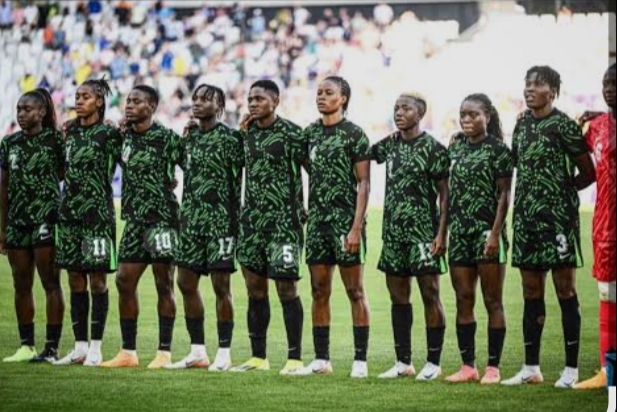
Nigeria’s Super Falcons have been eliminated from the race for the 2027 FIFA Women’s World Cup after suffering a 2-1 defeat to South Africa in the Women’s Africa Cup of Nations (WAFCON) qualification play-off on Thursday.
The defeat in Morocco ended Nigeria’s hopes of securing one of Africa’s remaining routes to the global tournament and dealt a major blow to the reigning African champions, who had been seeking to maintain their remarkable record of appearing at every edition of the FIFA Women’s World Cup since the competition began in 1991.
South Africa produced a determined performance to claim the crucial victory, with Thembi Kgatlana and Refiloe Jane finding the net before Christy Ucheibe pulled one back for Nigeria deep into stoppage time.
The result means the Super Falcons will not be among the African representatives at the 2027 Women’s World Cup in Brazil, bringing an end to their historic uninterrupted run of nine World Cup appearances. FIFA records show that Nigeria had featured at every previous edition of the tournament, with their best performance coming in 1999 when they reached the quarter-finals.
South Africa Strike Twice
The contest was decided in the second half after both teams struggled to break the deadlock during the opening period.
South Africa eventually found the breakthrough in the 56th minute through Kgatlana, who put Banyana Banyana ahead and immediately placed Nigeria under pressure.
The Super Falcons attempted to respond but could not find an equaliser before South Africa extended their advantage.
Jane scored South Africa’s second goal in the 77th minute, leaving Nigeria with a difficult task in the closing stages of the encounter.
Nigeria refused to surrender and continued pushing forward in search of a lifeline.
Their persistence finally paid off in the fourth minute of stoppage time when Ucheibe scored to reduce the deficit to 2-1.
The goal gave the Nigerians a brief opportunity to mount a dramatic comeback, particularly after South Africa were reduced to 10 players following Jane’s red card shortly before Nigeria’s goal.
However, the Falcons were unable to find another breakthrough before the final whistle, and South Africa held on to secure the victory.
The result was particularly painful for Nigeria because the team entered the WAFCON as defending champions and one of Africa’s most successful women’s football sides.
World Cup Qualification At Stake
The 2026 WAFCON is serving as Africa’s qualification tournament for the 2027 FIFA Women’s World Cup.
Under the qualification format, the four teams that reach the WAFCON semi-finals automatically earn places at the World Cup in Brazil. The four teams eliminated in the quarter-finals, however, are given another opportunity through play-off matches.
FIFA explained that the four losing quarter-finalists would contest play-offs, with the two winners advancing to the intercontinental play-off tournament for another opportunity to qualify for Brazil 2027.
Nigeria’s defeat to South Africa therefore carries consequences beyond the WAFCON competition itself.
Having failed to reach the semi-finals, the Super Falcons needed to win their play-off match to remain in contention for one of Africa’s additional World Cup places.
That opportunity has now disappeared following the 2-1 loss.
South Africa, on the other hand, have kept their World Cup hopes alive and moved closer to another appearance on the global stage.
The other losing quarter-finalists are also involved in the remaining qualification battle, with the play-off system designed to produce two African teams for the FIFA intercontinental qualification tournament.
Historic World Cup Record Ends
Nigeria’s elimination represents a significant moment in the history of African women’s football.
The Super Falcons had been the only African nation to appear at every FIFA Women’s World Cup since the inaugural tournament in 1991.
FIFA lists Nigeria with nine previous World Cup appearances, including campaigns in 1991, 1995, 1999, 2003, 2007, 2011, 2015, 2019 and 2023. Their quarter-final appearance in the United States in 1999 remains their best performance at the tournament.
That remarkable record has now come to an end.
For a country that has traditionally dominated women’s football on the continent, the failure to qualify for Brazil 2027 will be regarded as one of the most significant setbacks in the team’s history.
The disappointment is even greater considering Nigeria arrived in Morocco as the reigning African champions after winning their 10th WAFCON title in 2025.
The Super Falcons defeated Morocco 3-2 in the final of the previous edition to reclaim the continental crown, extending their status as the most successful team in the history of the competition.
From Continental Champions To World Cup Elimination
Nigeria’s campaign in Morocco has therefore taken an unexpected turn.
The Super Falcons were expected to challenge strongly for another WAFCON title, but their World Cup ambitions became the immediate priority after they were knocked out in the quarter-finals.
The expanded 16-team tournament provided an additional qualification route for teams that failed to reach the semi-finals, meaning Nigeria still had a chance to stay in the race.
That second opportunity has now been squandered.
South Africa’s victory also adds another chapter to the growing rivalry between the two nations.
The teams have developed one of the strongest rivalries in African women’s football in recent years, with both countries regularly competing for continental honours and major tournament qualification.
Nigeria had previously defeated South Africa 2-1 in the semi-finals of the last WAFCON, with Michelle Alozie scoring a dramatic stoppage-time winner.
This time, however, it was South Africa who produced the decisive result when the stakes were even higher.
A Major Setback For Nigerian Football
The Super Falcons’ elimination is likely to trigger questions about the direction of Nigerian women’s football, particularly after the team’s historic success in the previous WAFCON.
Nigeria remain one of Africa’s most decorated women’s football nations, but the increasing competitiveness of the continent has made qualification for major tournaments more challenging.
South Africa, Morocco, Zambia, Ghana, Cameroon and other emerging teams have continued to narrow the gap with Nigeria, creating a more competitive African football landscape.
The defeat also means that Nigeria’s attention will now shift away from World Cup qualification and towards rebuilding for future international competitions.
For the players, the immediate disappointment will be difficult to absorb. The team had entered the tournament carrying the expectations associated with a record 10-time African champion.
Instead, their campaign has ended with a defeat that will have consequences well beyond the current WAFCON.
The final scoreline — South Africa 2, Nigeria 1 — tells only part of the story.
It represents the end of Nigeria’s historic World Cup streak, the collapse of their hopes of defending the WAFCON crown and, most significantly, their elimination from the qualification pathway for the 2027 FIFA Women’s World Cup.
For the first time since the women’s global tournament began, the Super Falcons will have to watch the World Cup from home.
The defeat is therefore not simply another early exit for Nigeria. It is the conclusion of an era in which the Super Falcons had been a constant presence on football’s biggest stage.
And with South Africa progressing in the qualification race, Nigeria will now be left to consider how to rebuild a side capable of returning to the world stage and restoring its dominance in African women’s football.