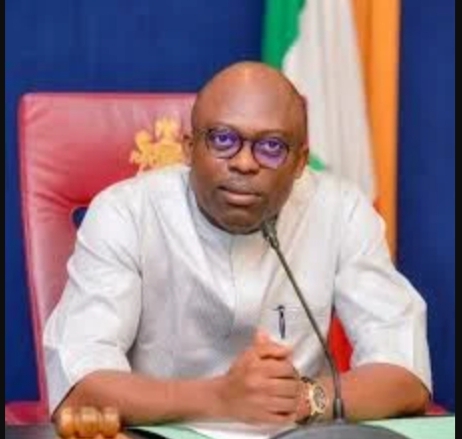
The Rivers State Government has dismissed reports of a fresh disagreement between Governor Siminalayi Fubara and members of the Rivers State House of Assembly over the delay in passing the State’s 2026 Appropriation Bill.
The Government described the reports as misleading, saying the budget proposal remains before the legislature and is progressing through the required legislative procedures.
The clarification was contained in a statement issued on Wednesday by the Chief Press Secretary to Governor Fubara, Onwuka Nzeshi, amid renewed attention on the relationship between the executive and legislative arms of Government in the State.
Nzeshi maintained that Fubara was not engaged in any confrontation with the lawmakers, insisting that the Governor was working with the Assembly in the interest of Rivers State.
According to him, the administration has no dispute with the lawmakers over the 2026 budget and remains confident that the proposal will receive the necessary legislative consideration and approval.
The statement came against the backdrop of reports suggesting that the delay in the passage of the budget could be evidence of another political disagreement between the Governor and the lawmakers.
Nzeshi, however, rejected such an interpretation, urging the public not to attach political tension to what he described as a normal legislative process.
“We wish to make it abundantly clear that His Excellency, Governor Siminalayi Fubara, is not at loggerheads with members of the Rivers State House of Assembly, but rather working closely with them to serve the good people of Rivers State,” he said.
The Chief Press Secretary further explained that the 2026 budget had already been presented to the House and was undergoing consideration in accordance with established procedures.
“The 2026 budget proposal has been presented to the House of Assembly; it is going through the normal legislative process and we strongly believe that once the process is completed, it will be passed by the lawmakers,” Nzeshi stated.
The development is significant because relations between the Rivers State executive and legislature have been at the centre of the State’s political crisis in recent years.
The dispute between Fubara and lawmakers loyal to former Governor and current Minister of the Federal Capital Territory, Nyesom Wike, had previously plunged Rivers State into prolonged political uncertainty.
The disagreement resulted in deep divisions within the State House of Assembly, including competing legislative camps and disagreements over the authority of the Governor and lawmakers.
The political crisis also affected the consideration of State legislation and budgets, making the progress of the 2026 Appropriation Bill an issue of particular political interest.
However, the atmosphere changed considerably following political reconciliation involving Fubara, Wike and the lawmakers.
Fubara subsequently appeared before the Martin Amaewhule-led House of Assembly on July 10 to present his 2026 budget proposal, marking a major departure from the prolonged confrontation that had characterised relations between the two arms of Government.
The Governor presented a proposed budget of ₦1.854 trillion, tagged the “Budget of Resilience for Growth and Development.” The proposal included ₦1.405 trillion for capital expenditure and ₦413.1 billion for recurrent expenditure.
The budget was designed to focus heavily on infrastructure, education, healthcare and other areas of public development.
Among the major capital allocations were ₦533.32 billion for works and infrastructure, ₦315 billion for education and ₦105.42 billion for healthcare. The proposal also earmarked funds for the Rivers State House of Assembly, judiciary, agriculture, power, youth development and other sectors.
During the presentation, Fubara urged the lawmakers to give the bill prompt consideration, stressing the need for cooperation between the executive and legislature to accelerate development in the State.
Speaker Amaewhule, on behalf of the Assembly, assured the Governor that lawmakers would give the proposal due consideration.
The bill subsequently passed its first reading, while the Governor and members of the Assembly were seen exchanging pleasantries after the proceedings, signalling a more cooperative relationship between the two branches of Government.
The Rivers State Government is now insisting that the delay in completing the budget process should not be interpreted as a return to the political hostility that previously characterised relations between Fubara and the lawmakers.
Nzeshi said Rivers State had already experienced considerable political difficulties and should not be subjected to another round of controversy based on what the Government considers inaccurate reports.
He therefore called on those promoting what he described as negative narratives to stop doing so, arguing that the State needs stability and cooperation to concentrate on development.
“We therefore advise all those bent on promoting negative narratives to desist from such actions forthwith, as we need peace and harmony to ensure steady development of Rivers State,” he said.
The statement also underscores the importance the Fubara administration attaches to maintaining the political truce that followed the reconciliation between the Governor, Wike and members of the Assembly.
For the Government, continued cooperation between the executive and legislature is necessary to enable the State to implement its development plans and address outstanding obligations.
The proposed 2026 budget itself came later than the conventional start of the fiscal year, following the political and administrative circumstances surrounding its preparation and presentation.
Before the appropriation bill was presented, the Governor had submitted the 2026–2028 Medium Term Expenditure Framework to the House in June. The framework is an important part of the budget preparation process and provides the fiscal basis for the annual appropriation bill.
The eventual presentation of the ₦1.854 trillion proposal in July was therefore viewed as an important step towards restoring normal executive-legislative relations in Rivers State.
The Government’s latest denial suggests that it wants the focus to remain on the legislative consideration of the budget rather than renewed speculation about political disagreements.
With the proposal already before the House, the next major stage is the completion of legislative scrutiny and passage of the bill.
If approved and subsequently assented to, the budget is expected to provide the financial framework for the Rivers State Government’s spending and development programmes for the 2026 fiscal year.
The administration has repeatedly presented infrastructure, education, healthcare and improved public services as key priorities under the proposal.
For now, the Rivers State Government maintains that there is no fresh battle between Governor Fubara and the lawmakers and that the budget delay should be viewed strictly within the context of the legislative process.
The administration is also appealing for political stability, arguing that the people of Rivers State stand to benefit more from cooperation between the executive and legislature than from another cycle of political confrontation.
The latest development therefore places the spotlight on whether the current reconciliation between Fubara and the lawmakers will translate into the timely completion of the 2026 budget process and sustained cooperation between both arms of Government.