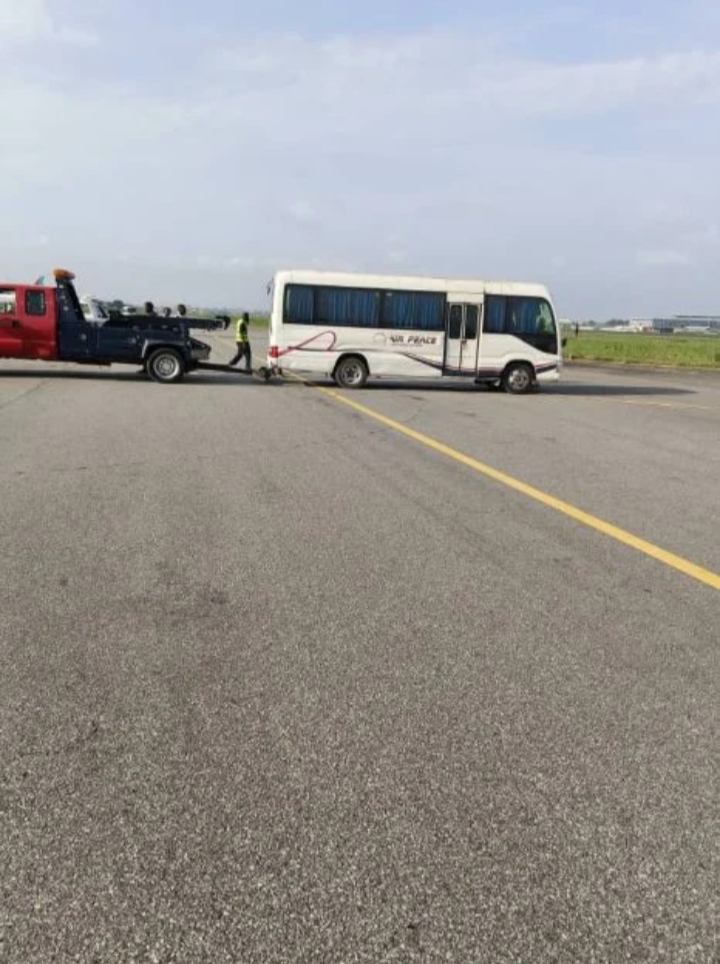
The Nigeria Civil Aviation Authority has ordered the identification, arrest and prosecution of a driver working with Air Peace following an incident involving one of the airline’s buses during Tuesday’s industrial action at the Murtala Muhammed Airport in Lagos.
The regulatory agency said the driver allegedly drove the vehicle onto the airport’s airside and left it there amid a picketing exercise organised by aviation unions against the airline.
The incident occurred as aviation workers began a coordinated protest against Air Peace over unresolved labour and regulatory issues, including allegations surrounding the remittance of statutory charges and concerns over workers’ freedom to belong to trade unions.
The development has added a fresh dimension to the dispute, with the NCAA treating the alleged obstruction of an airport operational area as a serious matter requiring investigation and possible criminal prosecution.
The unions involved in Tuesday’s action included the National Union of Air Transport Employees, the Air Transport Services Senior Staff Association of Nigeria and the National Association of Aircraft Pilots and Engineers.
The Nigeria Labour Congress and the Trade Union Congress also backed the industrial action.
The unions had previously issued warnings to airlines over their grievances, eventually moving to picket affected operators after what they described as several weeks of unsuccessful efforts to secure a resolution.
One of the major issues behind the dispute is the alleged non-remittance of the five per cent Ticket Sales Charge. The charge is collected from passengers and is intended to support the funding of aviation agencies.
The unions have also raised concerns about alleged restrictions placed on workers who want to join trade unions within some domestic airlines.
According to the labour groups, some employees allegedly fear discrimination or victimisation if they openly express interest in union membership.
They maintained that Tuesday’s picketing was not their first attempt to resolve the matter, describing the action as the outcome of a prolonged disagreement with affected airlines.
However, the protest itself became the subject of a separate aviation safety and security concern after the Air Peace bus was reportedly driven into the airside.
An airport source told journalists that the driver allegedly positioned the bus in the area and abandoned it while the protest was ongoing.
The Federal Airports Authority of Nigeria subsequently had to tow the vehicle away, according to the source, in order to clear the area and restore unrestricted movement around the airside.
The incident attracted the attention of the NCAA, which said it would investigate the circumstances surrounding the vehicle’s presence in the restricted area.
The NCAA’s Director of Public Affairs and Consumer Protection, Michael Achimugu, confirmed that the Authority had directed that the driver be identified and arrested.
Achimugu said the agency considered the alleged obstruction of the runway or an operational airport area unacceptable, stressing that relevant provisions of aviation law would be applied if the investigation established a violation.
He explained that he was engaged in a previously scheduled meeting with airline operators when the incident occurred but subsequently received information from another aviation agency about what had happened.
According to the NCAA official, preliminary information indicated that the driver took a large bus onto the runway area, parked it and left the location.
The Authority therefore instructed the relevant agencies to identify the individual involved and commence the process leading to his arrest and prosecution.
The NCAA’s position underscores the seriousness with which aviation authorities treat unauthorised obstruction of areas used for aircraft operations.
Airports rely on strict controls governing access to runways, taxiways and other airside facilities because vehicles or individuals entering such locations without proper authorisation can interfere with aircraft movements and create safety risks.
The regulatory agency has therefore said it will investigate the incident before determining the specific legal provisions to invoke.
Despite the NCAA’s position, Air Peace has rejected the description of the incident as a runway blockage.
The airline’s spokesperson, Efe Whiskey-Osifo, challenged the allegation and insisted that the bus did not block the runway.
Whiskey-Osifo asked for photographic evidence to substantiate the claim, questioning whether the vehicle had actually been positioned on the runway in the manner alleged.
The conflicting accounts mean that the exact location of the bus and whether it obstructed a runway remain issues for the relevant authorities to establish through their investigation.
The controversy comes at a time when the unions’ action has already caused disruption to flight operations.
The coordinated picketing was directed at Air Peace as part of the workers’ broader campaign to compel airlines to address their grievances.
Reports from Tuesday indicated that the industrial action affected airport activities, leaving passengers dealing with disruptions as aviation workers moved to enforce the protest.
The situation also places renewed attention on the relationship between airline operators, aviation regulators and organised labour in Nigeria’s aviation industry.
The five per cent Ticket Sales Charge has been a recurring issue in discussions involving airlines and aviation agencies, particularly because of its role in financing the operations of key institutions within the sector.
For the unions, the dispute goes beyond financial obligations. They have also linked their action to the rights of aviation workers to freely organise and participate in trade unions without fear of retaliation.
For the NCAA, however, the reported movement of an airline bus into a restricted operational area raises an independent regulatory concern.
The Authority is expected to establish whether the driver knowingly entered a prohibited area, whether the vehicle actually obstructed aircraft operations and what circumstances led to the bus being left at the location.
Until that investigation is completed, the allegation against the driver remains unproven.
Nevertheless, the NCAA has made clear that it intends to pursue the matter, including possible arrest and prosecution of the driver once he is identified.
The development adds another layer to the ongoing confrontation between Air Peace and aviation labour unions, which began over demands relating to regulatory payments and workers’ unionisation rights.
While the unions continue to press their demands, Air Peace has disputed the NCAA’s account of the bus incident.
The outcome of the investigation will determine whether the driver breached aviation regulations and whether further legal action will follow.
For now, the NCAA’s order for the driver to be identified, arrested and prosecuted remains the latest development in Tuesday’s airport confrontation, as authorities seek to separate legitimate industrial action from conduct that could compromise aviation safety.