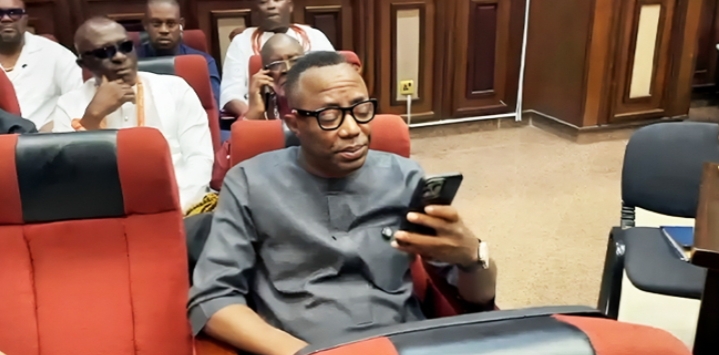
Court Adjourns Sowore Defamation Trial After Lawyers Clash
The ongoing criminal defamation trial involving activist and presidential candidate, Omoyele Sowore, was temporarily halted on Monday after a heated disagreement between senior lawyers representing both sides disrupted proceedings at the Federal High Court in Abuja.
The courtroom exchange, which centered on an application for an adjournment, prompted Justice Mohammed Garba Umar to caution counsel over their conduct before postponing further hearing in the matter until September 20, 2026.
The case, instituted by the Department of State Services (DSS), has experienced several delays in recent months, with the latest proceedings ending abruptly after tempers flared between counsel for the defence and the prosecution.
Defence Seeks Adjournment Over Court Documents
The dispute began when Sowore’s lead counsel, Adeyinka Olumide-Fusika (SAN), asked the court for more time, explaining that certified court documents required for the next phase of the defence were only released on Monday despite an earlier approval.
According to him, the defence intended to cross-examine a DSS witness but could not effectively proceed because the necessary Certified True Copies (CTCs) of court records had not been made available in time.
Olumide-Fusika informed the court that his legal team submitted its application for the documents on July 22, 2026, but officials at the court registry repeatedly maintained that approval from the trial Judge had not been granted.
He said the defence later discovered that Justice Umar had actually approved the request on July 27, suggesting that the delay stemmed from an administrative issue within the registry rather than any fault of the court.
The senior advocate argued that the documents were essential to the defence strategy and would form the basis of the questions intended for the DSS witness.
Prosecution Opposes Request
Counsel for the DSS, Akinlolu Kehinde (SAN), strongly opposed the application, urging the court to reject the request for another adjournment.
He argued that the prosecution had fulfilled its obligations by ensuring that the nominated DSS officer was present in court to testify, insisting that the defence should not be allowed to prolong the proceedings further.
Kehinde maintained that once the defence filed an application for certified records, it was its responsibility to diligently monitor and pursue the request at the court registry instead of waiting until the hearing date.
He further submitted that the repeated adjournments sought by the defence had unnecessarily prolonged the case and urged the court to close the defence if it was unwilling or unable to proceed.
Referring to constitutional provisions on fair hearing, the prosecution argued that the law guarantees parties the opportunity to present their case but does not permit endless delays that frustrate judicial proceedings.
Defence Rejects Allegations of Delay
Responding to the prosecution’s submissions, Olumide-Fusika denied any attempt to deliberately slow down the trial.
He insisted that the defence had consistently acted in good faith and blamed the delay solely on administrative shortcomings at the court registry.
The senior lawyer argued that if the defence intended to frustrate the proceedings, it could have insisted that the Director-General of the DSS personally appear in court under the subpoena previously issued to him.
Instead, he said the defence had accepted that another DSS official would testify but still required the certified records to conduct an effective cross-examination.
He also relied on provisions of the Evidence Act, arguing that the requested documents were material and relevant to the defence’s intended line of questioning.
Olumide-Fusika described suggestions that the defence was intentionally delaying the case as unfair, stressing that attending repeated court sessions involved considerable financial and professional commitment.
Judge Notes Previous Adjournments
While considering the application, Justice Umar observed that the prosecution had already closed its case and that the defence had so far called only one witness.
The Judge also remarked that the matter had previously been adjourned on several occasions at the instance of the defence.
In response, Olumide-Fusika presented a detailed account of events dating back to June 22, 2026, when he formally assumed responsibility for the case, in an effort to demonstrate that the defence had acted diligently throughout the proceedings.
Heated Exchange Interrupts Proceedings
The atmosphere in court became increasingly tense when Kehinde rose to make additional submissions.
Before he could conclude, Olumide-Fusika interrupted him, accusing the prosecution of acting like a “persecutor” instead of a prosecutor.
The remark immediately drew the attention of Justice Umar, who firmly reprimanded the defence counsel and warned against any further outbursts.
The Judge cautioned both senior advocates to maintain professionalism, warning that any repeat of such conduct could result in referrals to the appropriate disciplinary authorities.
Following the exchange, Justice Umar decided it would not be appropriate to continue with the day’s proceedings.
He subsequently adjourned the trial until September 20, 2026, when the defence is expected to continue presenting its case.
Trial Continues Amid Earlier Delays
The latest adjournment adds another chapter to a case that has witnessed multiple procedural delays in recent months.
In July, the Federal High Court had already warned that repeated requests for adjournments could eventually lead to the defence being foreclosed if proceedings failed to move forward.
The current proceedings relate to criminal defamation allegations filed by the DSS against Sowore over social media posts, allegations which he has denied.
Although Monday’s hearing was expected to advance the defence’s case through the testimony of a DSS witness, the disagreement over access to certified court documents ultimately prevented substantive proceedings.
With the matter now fixed for September 20, attention will shift to whether the defence can proceed with its witness examination and whether the long-running trial will finally move into its next substantive phase.
The court’s warning to both counsel also signals that future proceedings are expected to be conducted with greater restraint as the high-profile case continues before the Federal High Court in Abuja.