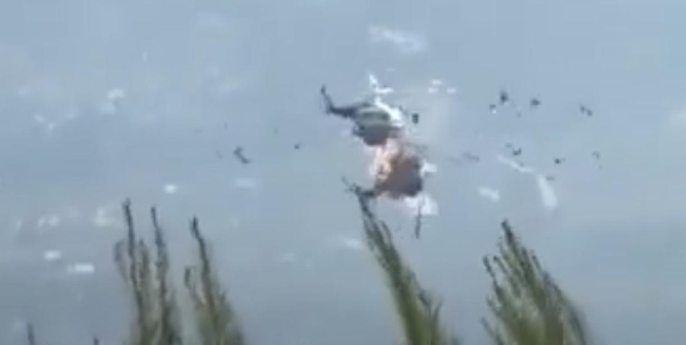
Two firefighting helicopters collided in mid-air on Sunday during an emergency operation to combat one of Greece’s most destructive wildfires of the year, adding to the country’s growing crisis as multiple fires continue to rage across several regions.
The accident happened in the Psatha area of western Attica, west of Athens, where aircraft and ground crews were battling an intense wildfire that has already destroyed more than 100 homes and scorched thousands of hectares of land. Authorities confirmed the helicopters were engaged in aerial water-dropping operations when the collision occurred.
According to Greek emergency officials, both helicopters were flying at low altitude while attempting to suppress the rapidly advancing flames. During the operation, the aircraft made contact in the air, resulting in one helicopter crashing while the other managed to remain airborne long enough for its crew to survive the incident. Initial rescue efforts were immediately launched as firefighters and emergency responders rushed to locate everyone involved.
Later on Sunday, Greece’s Fire Service confirmed that two crew members aboard one of the helicopters died in the crash, while the crew of the second aircraft survived. Authorities have launched an investigation to determine the cause of the mid-air collision.
The tragic incident highlights the dangerous conditions confronting emergency responders as Greece battles another severe wildfire season driven by soaring temperatures, dry vegetation and strong winds.
The fire near Porto Germeno spread rapidly across mountainous terrain, pushing toward residential communities and forcing emergency services to deploy hundreds of firefighters, dozens of fire engines and multiple aircraft in an effort to stop the flames from reaching densely populated areas.
Officials said one of their biggest concerns remained protecting the coastal town of Megara, where approximately 30,000 residents live. Firefighters worked tirelessly to create containment lines while aircraft repeatedly dropped water on advancing fire fronts.
Authorities also ordered evacuations in several settlements across western Attica as changing wind conditions threatened additional communities. Emergency alerts urged residents to leave immediately while rescue teams remained on standby to assist anyone unable to evacuate safely.
Residents also joined the firefighting effort, using hoses, buckets and farming equipment to protect homes and nearby vegetation from the advancing flames.
One local resident said people understood that firefighters could not be everywhere at once because of the enormous scale of the disaster, prompting many villagers to defend their own properties until emergency crews arrived.
Greek Prime Minister, Kyriakos Mitsotakis, acknowledged that the wildfire emergency had stretched the country’s response capabilities, saying the intensity of the weather had overwhelmed even extensive emergency planning.
Reports from local media indicated that the wildfire has already consumed more than 10,000 hectares of land, making it one of Greece’s largest blazes this year. Vast stretches of forest, farmland and residential areas have suffered significant damage, while authorities continue assessing the full extent of the destruction.
The emergency is not limited to mainland Greece.
Fresh evacuation orders were also issued on the Ionian island of Kefalonia after another wildfire erupted in the Pastra area, threatening homes and forcing residents and tourists to move to safer locations overnight. Firefighters continued battling multiple active fire fronts across the island.
Across Europe, prolonged heatwaves and exceptionally dry weather have fueled an unusually intense wildfire season.
France has reported improvements after major fires burned through parts of the Gironde and Var regions, although emergency services remain on alert for isolated flare-ups. Spain has also managed to contain several large fires after extensive firefighting operations, though crews continue monitoring areas vulnerable to reignition.
In Spain’s western province of Cáceres, hundreds of residents who had earlier been evacuated because of a forest fire were allowed to return home. However, authorities advised them to remain indoors while firefighters completed mopping-up operations and monitored hotspots.
Beyond wildfires, Europe is also experiencing worsening drought conditions that are placing enormous pressure on water supplies and critical infrastructure.
Water levels in major rivers such as the Danube and the Rhine have fallen sharply, disrupting shipping, tourism and electricity generation across several countries.
Hungary has been particularly affected, with historically low Danube water levels forcing the temporary shutdown of its only nuclear power plant for the first time in more than four decades. Authorities have also imposed water-use restrictions in more than 100 towns and villages. Serbia has also reported exceptionally low Danube levels, reducing electricity production at one of its largest hydropower stations.
Scientists have repeatedly warned that climate change is increasing the frequency and intensity of extreme heatwaves across southern Europe, creating conditions that allow wildfires to spread more quickly and become harder to control.
The deadly helicopter collision has become one of the most tragic incidents of Greece’s 2026 wildfire season, highlighting the extreme risks faced by aerial firefighting crews and the growing challenge European countries face in responding to increasingly destructive climate-related disasters.