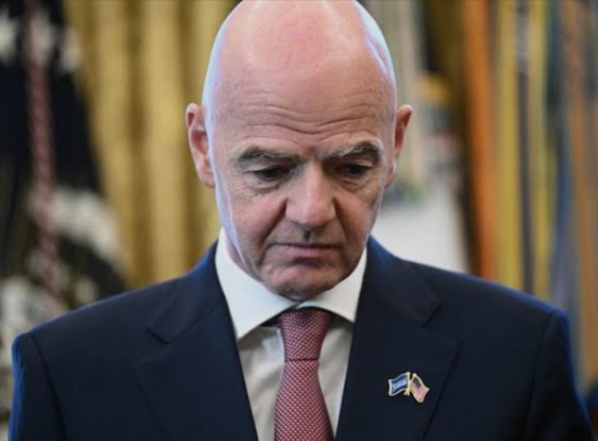
A major leadership crisis has erupted within world football after UEFA openly declared that it has lost confidence in FIFA President, Gianni Infantino, accusing him of attempting to push through a controversial World Cup investment proposal behind closed doors.
The unprecedented criticism came after FIFA abandoned its plan to open up private investment in the commercial rights of the FIFA World Cup following days of fierce opposition from football confederations across the globe. Although Infantino eventually withdrew the proposal, UEFA insisted the decision did little to repair the damage already done, saying trust in the current FIFA leadership had been severely eroded.
In one of its strongest public attacks on FIFA in recent years, European football’s governing body accused Infantino of operating through an opaque process that sidelined stakeholders and violated the principles of transparency he had promised when he first took office.
The backlash intensified on Saturday after FIFA officially confirmed it would no longer proceed with the proposed investment project.
In a statement announcing the reversal, Infantino said FIFA’s objective had always been to strengthen the global game and unite its member associations.
“Our purpose has always been — and will always be — to unite and improve,” Infantino stated.
He added that after listening to concerns raised by football stakeholders, FIFA had decided not to move forward with the proposal.
“As a result, this proposal will not proceed,” he said.
The investment initiative, first unveiled on Tuesday, involved the creation of a new commercial subsidiary known as FIFA Forward Enterprise (FFE). Under the proposal, the entity would oversee commercial assets linked to tournaments including the FIFA World Cup and the FIFA Club World Cup.
FIFA projected that the new structure could attract as much as $4.2 billion in private investment based on an estimated valuation of $20 billion.
The governing body argued that the project would generate significant financial benefits for its 211 member associations. If approved, every association was expected to receive a one-time payment of $20 million in early 2027.
FIFA also proposed increasing development funding allocated to each member association for the 2027–2030 cycle from $8 million to $20 million.
Despite those financial incentives, the proposal immediately triggered widespread resistance from football authorities around the world.
UEFA emerged as the strongest opponent, warning that it was prepared to boycott FIFA competitions if the investment plan went ahead.
Although FIFA eventually abandoned the proposal, UEFA said the withdrawal did not erase what it described as a serious breach of trust.
The European governing body issued a strongly worded statement accusing Infantino of attempting to force through a secretive agreement without proper consultation.
According to UEFA, the current FIFA administration has not only lost the confidence of European football but also that of many other members of the global football community.
The organisation reminded Infantino of commitments he made when he successfully campaigned for the FIFA presidency in 2016, promising openness, accountability and transparency.
UEFA recalled that Infantino had assured member associations that FIFA’s finances belonged to them rather than to the FIFA President.
The governing body argued that those commitments had not been honoured.
It accused Infantino of abandoning the transparency principles on which he built his leadership campaign and criticised what it described as a “shabby, back room, opaque” process used to advance the investment proposal.
UEFA also questioned FIFA’s financial justification for seeking outside investors.
The organisation noted that FIFA currently holds reserves exceeding $5 billion, arguing that those resources should have been deployed directly for the benefit of football rather than pursuing external investment.
The latest confrontation comes less than two weeks after Infantino enjoyed widespread praise following what many regarded as a successful FIFA World Cup.
The recently concluded tournament marked the first edition featuring 48 national teams and was jointly hosted by three countries, a milestone widely viewed as a success for FIFA.
However, the controversy surrounding the investment proposal has quickly overshadowed that achievement and placed renewed scrutiny on Infantino’s leadership.
His political standing within FIFA has also come under increasing pressure.
For years, Infantino appeared to have a relatively smooth path toward securing another term as FIFA President.
However, following the latest controversy, that once comfortable position is now facing open questioning ahead of next year’s election.
The criticism has not been limited to UEFA.
The Asian Football Confederation (AFC) also welcomed FIFA’s decision to abandon the proposal, although it adopted a more measured tone.
The Kuala Lumpur-based organisation said any initiative capable of reshaping global football should be presented to confederations, FIFA Council members, national associations and other stakeholders through a timely, transparent and meaningful consultation process.
The Confederation of North, Central America and Caribbean Association Football (CONCACAF) also opposed the proposal.
The confederation represents 47 member nations, including the United States, Canada and Mexico, the three countries scheduled to co-host the next FIFA World Cup.
South America’s governing body, CONMEBOL, also sought greater clarity over the proposal.
Although CONMEBOL President, Alejandro Dominguez, is widely regarded as a close ally of Infantino, the organisation requested additional information regarding the project’s scope, governance structure and its potential long-term impact on world football.
The Confederation of African Football (CAF) had earlier encouraged its member associations to examine the proposal ahead of a planned meeting scheduled for next week.
With FIFA’s decision to withdraw the project, that meeting is no longer expected to serve its original purpose.
Pressure on Infantino intensified further on Friday when senior FIFA adviser, Carlos Cordeiro, resigned from his position.
Cordeiro openly criticised the proposal, describing it as a bad deal for FIFA’s member associations, harmful to football and damaging to the sport’s long-term future.
In explaining why FIFA ultimately abandoned the project, Infantino acknowledged that divisions created by the proposal had become too significant to ignore.
He said the initiative had originally been designed to strengthen member associations but would only have been implemented if it enjoyed majority backing.
According to the FIFA President, consultations made it clear that the disagreement surrounding the proposal had become more damaging than any potential benefit it was intended to deliver.
Infantino pledged to focus on rebuilding relationships across world football and restoring unity among FIFA’s stakeholders.
He said his priority in the coming days and weeks would be to bring all interested parties back together in the spirit of shared interest while continuing efforts to expand football worldwide.
The FIFA President added that special attention would continue to be given to countries requiring greater support as the organisation works toward growing the game across every region of the world.
The collapse of the investment proposal marks one of the most significant political setbacks of Infantino’s presidency and exposes growing divisions within international football administration.
With UEFA publicly questioning his leadership, several major confederations demanding greater transparency and internal criticism continuing to mount, the controversy has evolved into one of the biggest governance challenges FIFA has faced in recent years.
Whether the withdrawal of the proposal is enough to restore confidence among football’s most influential stakeholders remains uncertain, but the dispute has undoubtedly intensified scrutiny of FIFA’s leadership ahead of another crucial election cycle.