Anambra Introduces Plea Bargain Framework: Soludo Govt Excludes Murder, Kidnapping, Armed Robbery, Rape
The Anambra State Government has officially introduced a plea bargain framework for defendants facing criminal prosecution in the state, excluding suspects charged with murder, kidnapping, armed robbery and rape.
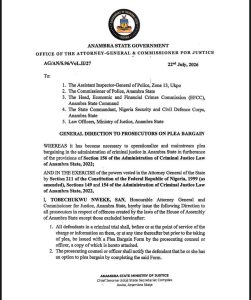
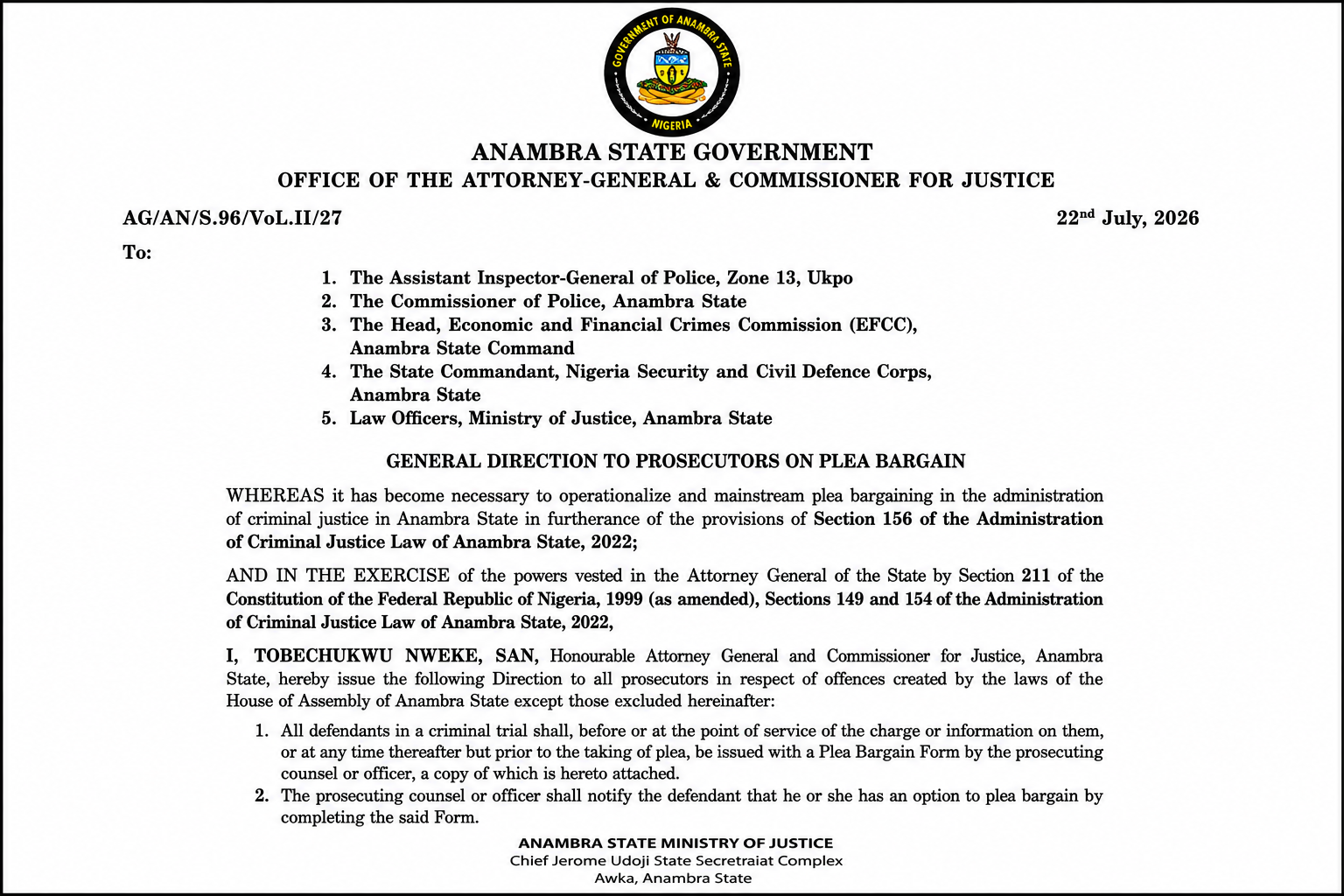
The new policy was unveiled through a formal directive issued on Tuesday, July 22, 2026, by the Office of the Attorney-General and Commissioner for Justice, Tobechukwu Nweke (SAN). The document, titled “General Direction to Prosecutors on Plea Bargain,” was addressed to key law enforcement and prosecuting agencies across the state.
Recipients of the directive include the Assistant Inspector-General of Police in charge of Zone 13, the Commissioner of Police in Anambra State, the Economic and Financial Crimes Commission (EFCC), the Nigeria Security and Civil Defence Corps, as well as law officers within the state Ministry of Justice.
According to the government, the measure forms part of broader efforts to strengthen the administration of criminal justice, reduce congestion in correctional facilities and accelerate court proceedings.
The directive cited Section 156 of the Administration of Criminal Justice Law of Anambra State, 2022, as the legal basis for mainstreaming plea bargaining in criminal cases. It also referenced the powers granted to the Attorney-General under Section 211 of the Constitution of the Federal Republic of Nigeria, alongside Sections 149 and 154 of the state’s criminal justice law.
In the official document, Attorney-General Nweke stated that the decision was necessary to fully operationalise plea bargaining within Anambra’s justice system.
The directive reads:
“Whereas it has become necessary to operationalize and mainstream plea bargaining in the administration of criminal justice in Anambra State in furtherance of the provisions of Section 156 of the Administration of Criminal Justice Law of Anambra State, 2022.”
The policy applies to all offences created under the laws enacted by the Anambra State House of Assembly, with the exception of murder, kidnapping, armed robbery and rape.
Under the new arrangement, prosecutors are required to issue a prescribed plea bargain form to defendants before or at the point when charges are served, or at any time before a plea is entered in court.
The directive specifically states:
“All defendants in a criminal trial shall, before or at the point of service of the charge or information on them, or at any time thereafter but prior to the taking of plea, be issued with a Plea Bargain Form by the prosecuting counsel or officer.”
It further directs prosecuting officers to inform defendants that they have the option of seeking a plea bargain by completing the relevant forms.
Separately, the Attorney-General’s office described the initiative as part of Governor Chukwuma Charles Soludo’s ongoing reforms aimed at improving the efficiency of the state’s justice sector.
According to the statement released by the Ministry of Justice:
“This rare discretionary privilege is part of the ongoing efforts of the State Government to decongest the correctional centres and the courts and to align with the ongoing reform of the criminal justice sector in the State in line with the mandate of the Governor, Prof. Chukwuma Charles Soludo.”
Plea bargaining allows defendants and prosecutors to negotiate agreements that may result in reduced charges, lesser sentences or quicker resolution of cases, subject to judicial approval. The mechanism is commonly used in many legal systems to ease pressure on overcrowded courts and correctional institutions.
Legal analysts note that prolonged detention and delays in criminal trials remain major challenges across Nigeria’s justice system. By expanding access to plea bargains, Anambra State hopes to speed up the disposal of cases while allowing prosecutors and judges to focus more attention on serious crimes.
The government’s decision to exclude offences such as murder, kidnapping, armed robbery and rape indicates that cases involving violent and grave crimes will continue to undergo full judicial processes without the possibility of negotiated settlements.
The directive has already taken effect and is binding on prosecutors handling offences created under Anambra State laws.
The latest move marks another step in Anambra’s broader justice reform programme, as the Soludo administration continues efforts to modernise public institutions and improve the delivery of legal services across the state.
With prosecutors now mandated to provide plea bargain forms at the earliest stages of criminal proceedings, the impact of the policy on court efficiency and prison congestion is expected to become clearer in the months ahead.