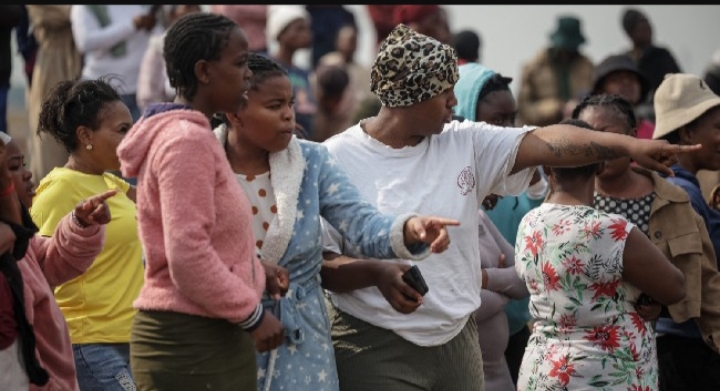
Police in South Africa are investigating the deaths of 11 women whose bodies have been discovered across the Ekurhuleni municipality, east of Johannesburg, over the past 10 weeks, with authorities yet to establish whether the cases are connected.
The latest discovery was made on Sunday, September 27, 2026, when the body of a woman was found in an open area in Struisbult, Springs, within the Ekurhuleni municipality.
According to police, a security company vehicle was patrolling the area around midday when personnel noticed the body and alerted the authorities.
The discovery has intensified concerns over a series of killings involving women in the municipality, eight of whom were reportedly found dead in September alone.
Gauteng police have deployed a multidisciplinary team to investigate the cases, involving detectives, crime-scene specialists, Crime Intelligence personnel and investigative psychology experts. Police officials are working to establish the circumstances surrounding each death and determine whether there is any connection between them.
Gauteng Police Commissioner, Lieutenant General Tommy Mthombeni, visited the latest crime scene in Springs as investigators began their preliminary examination.
A local report said the latest victim was believed to be about 20 years old. Police said she had been found partially unclothed, with her top lifted while her trousers remained on. Mthombeni also said there were injuries around her neck that raised the possibility of strangulation.
Her identity had not been established at the time of the initial investigation, and authorities said a post-mortem examination would be necessary to determine the precise cause of death.
The latest case came only a day after another woman was found dead at Mooifontein Cemetery in Thembisa, also within Ekurhuleni.
The victim, identified as Ntombifuthu Nxumalo, was reportedly found naked with serious injuries to her head. Police said stones were found around her body, raising the possibility that she had been stoned. No obvious stab wounds were found at the scene.
Investigators later arrested a man in Limpopo who was allegedly linked to Nxumalo’s death. Police said the suspect had left the area after the killing and was traced to Mohlabaneng village, where officers arrested him while he was asleep at his residence.
The arrest brings the number of people currently in police custody in connection with cases involving women in the area to four.
However, police have stressed that the separate killings have not been formally linked.
The distinction is important because the discovery of multiple bodies within the same municipality and over a relatively short period has raised fears among residents and prompted questions about whether a common perpetrator or pattern could be involved.
Authorities have so far stopped short of confirming that the deaths were carried out by one person or organised group.
Several of the victims were women in their 20s and 30s. Some were reportedly found without clothes or with indications of sexual assault, adding to concerns surrounding violence against women in the country.
The investigations have also revived memories of previous serial killings in South Africa, although police have cautioned against drawing conclusions before forensic and investigative evidence establishes links between the cases.
Earlier in September, authorities formed a specialised task team to examine the deaths and determine whether similarities exist among the incidents. Police have also been examining information from different crime scenes and reviewing evidence that could help establish possible connections.
The deaths have occurred against the backdrop of South Africa’s longstanding struggle with gender-based violence.
The country has continued to face high levels of violence against women despite Government initiatives and support programmes aimed at addressing the problem. The issue has been elevated to a national priority, with authorities maintaining services designed to assist victims and survivors.
Figures from South Africa’s Gender-Based Violence Command Centre further illustrate the scale of the problem.
Between September 1 and 16, the Centre reportedly received 6,782 distress calls. That amounts to an average of more than 400 calls every day and represented a 21 per cent increase compared with the corresponding period in August.
The growing number of deaths in Ekurhuleni has consequently generated anxiety among women living and working in the affected communities.
The latest discovery in Springs is the second body of a woman found in the area, according to local reporting. The body of 38-year-old Dineo Evelyn Motapane was discovered along Moshoeshoe Street in Kwa-Thema on September 15.
Meanwhile, police continue to appeal for information that could assist the investigations.
The immediate focus remains on identifying the latest victim, determining how she died and establishing whether evidence from her case matches evidence recovered from the other crime scenes.
Police are also expected to rely on forensic examinations, witness accounts, surveillance footage and intelligence gathering as they attempt to reconstruct the circumstances surrounding the deaths.
For now, investigators have not publicly confirmed a single motive behind the killings or established that the victims were targeted by the same person.
As the investigation continues, the discovery of the 11th body has placed renewed attention on the safety of women in Ekurhuleni and South Africa’s broader struggle to curb violence against women.
Authorities say the investigations remain active, with specialised police units working alongside forensic personnel to determine what happened to each victim and whether any links exist between the cases.
Until those investigations are completed, police are treating the deaths as separate cases while examining possible connections.
The latest discovery has nevertheless deepened public concern, as families, residents and women’s groups await answers about the circumstances surrounding the deaths and the identification of those responsible.