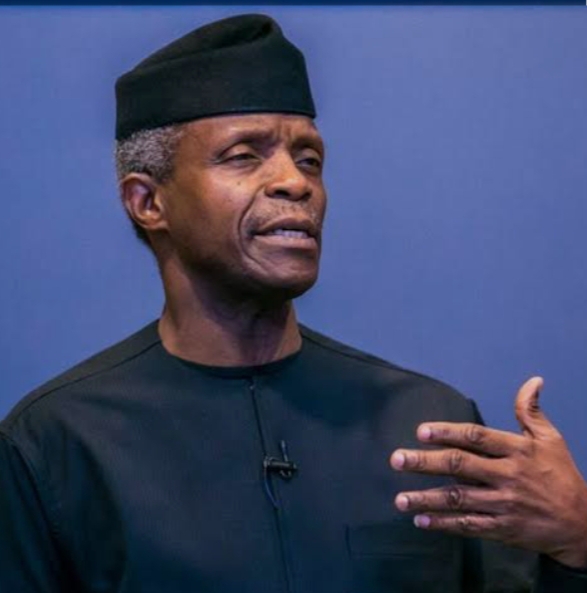
Former Vice-President, Yemi Osinbajo, has urged Nigeria to fundamentally rethink its approach to university education, saying Open and Distance Learning (ODL) must no longer be treated as a secondary option but as a national necessity for expanding access to higher education.
Osinbajo made the call on Tuesday in Lagos while speaking at the Fifth International Colloquium of the University of Lagos Distance Learning Institute (DLI).
The event, which brought together academics, education policymakers and other stakeholders from Nigeria and abroad, was themed “Reimagining Open Distance Learning Ecosystem: Technology, Policy and Institutional Priorities.”
The former Vice-President said the increasing number of young Nigerians seeking admission into universities had made it difficult for the conventional university system to meet the country’s educational needs.
He noted that about 2.2 million candidates sought admission to universities in 2026, while only a fraction of those seeking university education could secure admission. Other reports from the colloquium put the admission rate at about 35 per cent this year.
According to Osinbajo, the situation could become more challenging in the coming years as Nigeria’s population and demand for higher education continue to increase.
He projected that the number of university applicants could rise to about 2.7 million and eventually exceed three million annually.
He explained that the country’s conventional universities would struggle to build enough lecture theatres, laboratories, teaching hospitals and other physical infrastructure required to accommodate such a rapidly growing student population.
For him, the challenge makes it imperative for Nigeria to move beyond viewing distance education as merely an alternative pathway for students who cannot attend conventional universities.
Instead, Osinbajo argued that Open and Distance Learning should become one of the major vehicles for delivering university education to millions of Nigerians.
“Distance learning” in this context, he explained, should not simply mean putting existing lecture materials online. Rather, it should involve the use of modern technology to create a learning system capable of reaching large numbers of students while still providing quality and personalised education.
Osinbajo particularly highlighted the potential of Artificial Intelligence to transform the delivery of distance education.
He said AI could make it possible for large numbers of students to receive personalised academic support through intelligent digital tutors.
Such systems, he explained, could help students understand difficult concepts, test their knowledge, translate educational materials and provide feedback based on individual learning needs.
The former Vice-President said the combination of ODL and AI could therefore help Nigeria address the longstanding problem of limited access to university education without relying solely on the construction of more physical campuses.
He also linked the expansion of distance learning to the changing nature of employment.
According to him, professionals in fields such as law, accounting, banking and engineering would increasingly need to update their knowledge and acquire new skills as technology continues to reshape industries.
This, he said, makes flexible and lifelong learning increasingly important.
Osinbajo, however, cautioned against treating technology as an end in itself. He stressed that technology should remain a tool for improving human capabilities and creating greater opportunities for people.
He called on education authorities, universities and policymakers to develop practical policies covering the use of technology, training of lecturers, assessment methods and the application of Artificial Intelligence in education.
The former Vice-President also urged the University of Lagos Distance Learning Institute to continue playing a leading role in shaping Nigeria’s ODL ecosystem.
He said distance learning could eventually become a principal means through which Nigeria fulfils its commitment to providing university education to millions of citizens.
The argument for a stronger ODL system was also supported by the Vice-Chancellor of the University of Lagos, Prof. Folasade Ogunsola.
Speaking earlier at the event, Ogunsola said Nigeria’s expanding youth population had made it increasingly difficult for the traditional university model to satisfy the demand for higher education.
She said the country has approximately 89 million young people between the ages of 15 and 30, making the development of alternative and flexible pathways to higher education particularly important.
Ogunsola said ODL could provide opportunities for categories of Nigerians who may be unable to participate fully in conventional university programmes.
She identified workers, persons living with disabilities and people residing far from university campuses among those who could benefit from flexible distance education.
The UNILAG Vice-Chancellor also disclosed that the university no longer indicates “distance learning” on certificates issued to graduates of its ODL programmes.
The policy, she explained, reflects the institution’s position that students who complete distance learning programmes should receive the same recognition as their counterparts who graduate through conventional programmes.
Ogunsola nevertheless argued that Nigeria’s approach to ODL must go beyond simply transferring conventional course materials to digital platforms.
She called for a model built around connected learning, greater student engagement, personalised education and improved learning outcomes.
According to her, Artificial Intelligence could play an important role in this transformation by supporting personalised instruction, providing immediate feedback, assisting with content development and assessment, and helping institutions identify students who may be struggling academically.
However, she warned that the adoption of AI and digital learning technologies also raises important concerns.
Academic integrity, data privacy, intellectual property, algorithmic bias and unequal access to digital technology, she said, must be addressed as universities expand their use of technology.
Ogunsola therefore called for policies that would encourage innovation without compromising academic standards, fairness or the integrity of university qualifications.
She also urged universities to develop institutional strategies that would make ODL an integral component of their operations rather than treating it as a peripheral programme.
The Director of UNILAG’s Distance Learning Institute, Prof. Risikat Dauda, similarly described ODL as increasingly important to Nigeria’s efforts to expand access to education, close skills gaps and prepare workers for a rapidly changing labour market.
Dauda, however, acknowledged that significant obstacles remain.
She identified inadequate broadband infrastructure, high internet data costs, gaps in digital literacy and concerns about how employers perceive ODL qualifications among the challenges confronting the sector.
She stressed that these issues must be addressed if Nigeria is to build a sustainable distance learning system capable of serving millions of students.
Dauda also urged participants and policymakers not to allow the recommendations emerging from the colloquium to remain on paper.
She called for the ideas discussed at the event to be translated into concrete institutional strategies, regulatory frameworks and national policies.
She warned that Nigeria could not afford to allow valuable recommendations from the gathering to end merely as a communiqué.
The DLI Director described the future of Open and Distance Learning as flexible, lifelong and increasingly driven by technology, while emphasising that its human purpose must remain central.
The colloquium featured Osinbajo as Chairman, while Emeritus Prof. Stephen Brown delivered the keynote address.
Academics and policymakers from Nigeria, Ghana, the United Kingdom and other countries participated in the event.
The discussions ultimately centred on a growing reality confronting Nigeria’s education system: the demand for university education is expanding faster than the country’s conventional infrastructure can accommodate.
With millions of young Nigerians seeking admission and the population expected to continue growing, stakeholders increasingly see ODL, supported by technology and responsible use of Artificial Intelligence, as a possible means of bridging the gap.
For Osinbajo, the question is therefore no longer whether Nigeria should embrace distance learning, but how quickly the country can build the policies, infrastructure and institutional capacity required to make it work at scale.