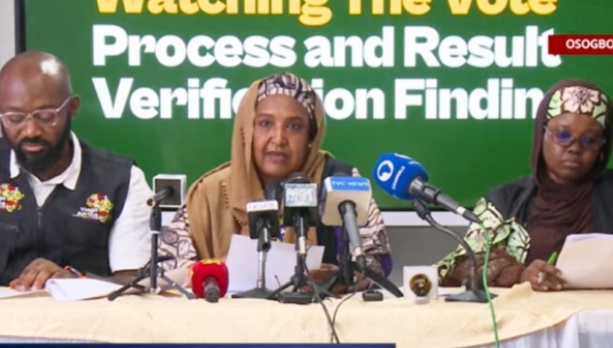
YIAGA Africa has commended the Independent National Electoral Commission (INEC) and security agencies for what it described as a largely satisfactory performance during the August 15, 2026, Osun State governorship election.
The civil society organisation, which monitored the poll alongside other election observation groups, said the exercise provided evidence that Nigeria’s electoral process can continue to improve ahead of the 2027 general elections.
Speaking during a post-election briefing on Sunday, Chairperson of the Election Observation Mission, Dr. Asmau Maikudi, said INEC and the security agencies had “largely passed the test” in the conduct of the Osun election.
Her assessment came a day after voters across the State participated in the governorship poll, which had attracted significant attention because of its importance to the political landscape ahead of the 2027 general elections.
INEC had scheduled the Osun governorship election for August 15, 2026, as part of its off-cycle election calendar.
According to YIAGA Africa, the results eventually announced by INEC were consistent with the organisation’s independent statistical analysis. The finding is significant because one of the central responsibilities of election observers is to independently assess whether the official outcome corresponds with the votes recorded at polling units.
YIAGA Africa has previously used its Process and Results Verification for Transparency (PRVT) methodology to independently verify election results. The organisation says the system enables it to collect information from a statistically representative sample of polling units and compare its findings with results announced by INEC.
The organisation’s latest assessment therefore represents an endorsement of the credibility of the official figures from the Osun poll, although it stopped short of describing the election as completely free of problems.
Maikudi said there were still shortcomings that required the attention of INEC and other electoral stakeholders.
The observers particularly highlighted voter participation, noting that turnout stood at about 43 per cent. YIAGA Africa described the level of participation as significant, while commending Osun voters for remaining engaged throughout the electoral process.
Another development praised by the organisation was the decision of voters to remain at polling units and observe the counting of ballots.
According to the group, the willingness of citizens to watch the votes being counted demonstrated the determination of voters to protect the integrity of their ballots and ensure that the results announced at the end of the process reflected what happened at polling units.
However, YIAGA Africa also raised a concern about the circumstances that made such citizen vigilance necessary.
The organisation argued that voters should not be placed in a situation where they feel compelled to physically stand guard over their votes before they can trust that their choices will be accurately reflected in the final results.
It said the development raised broader questions about public confidence in the electoral process and the integrity of election management.
The concern is particularly relevant as Nigeria prepares for the 2027 general elections, when the credibility of INEC, security agencies, political parties and other electoral stakeholders will again come under intense scrutiny.
YIAGA Africa’s assessment suggested that while the Osun election recorded improvements, there remains a need to strengthen institutional processes so that citizens can have greater confidence in elections without having to personally monitor every stage of the voting and counting process.
The organisation also said the Osun election demonstrated that INEC has the capacity to improve its electoral standards.
It consequently urged the Commission to build on the lessons from the exercise instead of treating the election as an isolated success.
The recommendation is coming after several elections in Nigeria in which observers have raised concerns about logistics, voter accreditation, ballot secrecy, vote buying, security conduct and the management of election results.
YIAGA Africa’s experience from previous elections shows that the organisation has consistently assessed both the quality of election-day procedures and the accuracy of declared results. During the 2025 Anambra governorship election, for instance, it confirmed that INEC’s announced results were consistent with its independent PRVT estimates.
The group has also previously identified weaknesses in Nigerian elections despite acknowledging improvements. During the 2026 Ekiti governorship election, for example, YIAGA Africa reported improvements in election-day administration but raised concerns about voter inducement, ballot secrecy, BVAS-related accreditation problems and discrepancies involving voter-register figures used to calculate turnout.
That background makes the Osun assessment particularly important, as the organisation’s commendation of INEC does not amount to a declaration that all electoral challenges have been resolved.
Instead, YIAGA Africa appears to be encouraging the electoral commission to consolidate the gains recorded during the Osun poll while addressing the weaknesses identified by observers.
The organisation said it would also provide recommendations to INEC ahead of the 2027 general elections.
Those recommendations are expected to focus on strengthening the electoral process, improving public confidence and ensuring that lessons from the Osun election are translated into practical reforms.
The role of security agencies was also central to the assessment. Maikudi’s statement that the agencies largely passed the test indicates that the election was generally managed without the level of widespread security failures that could have seriously disrupted voting and result collation.
For an off-cycle election taking place in a politically sensitive period, the conduct of security personnel remains crucial to protecting voters, election officials, observers and electoral materials.
YIAGA Africa’s commendation therefore places emphasis on the need to maintain professionalism and neutrality as Nigeria moves closer to the 2027 elections.
The organisation’s message to INEC is essentially that progress has been recorded, but more work remains.
For voters, the strong participation recorded in Osun and their determination to observe the counting process demonstrate continued interest in the democratic process. For INEC, however, the challenge will be to convert that public interest into greater institutional trust.
The Osun election is one of the major electoral exercises taking place before Nigeria’s 2027 general elections. INEC’s current election calendar lists the presidential and National Assembly elections for January 16, 2027, followed by governorship and State House of Assembly elections on February 6, 2027.
As political parties begin positioning themselves for the 2027 contests, the conduct of the Osun poll and the observations from election monitors are likely to remain relevant in discussions about Nigeria’s electoral reforms.
YIAGA Africa’s latest verdict, therefore, offers a mixed assessment: INEC and security agencies largely performed well, the official results were consistent with the organisation’s statistical findings, and voters demonstrated strong commitment to protecting their ballots.
At the same time, the organisation has made clear that improvements must continue.
Its central recommendation is that INEC should study the successes and shortcomings of the Osun election and use the lessons to strengthen the country’s electoral system ahead of 2027.
The ultimate test, YIAGA Africa suggested, will be whether those lessons result in an electoral process where citizens can trust that their votes will be protected and accurately reflected without having to personally stand guard over them.