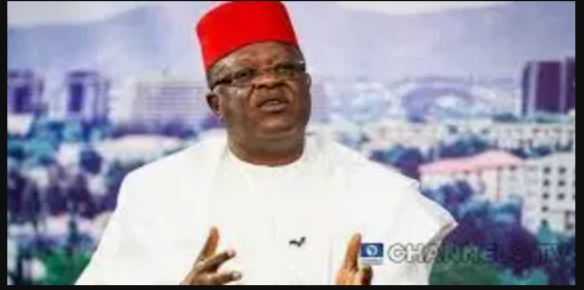
Umahi Explains Benin-Onitsha Road Delay
The Minister of Works, David Umahi, has defended the Federal Government against accusations that it neglected the Benin-Onitsha Road, saying a major portion of the corridor is covered by a long-term concession agreement that places specific responsibilities on a private concessionaire.
Umahi made the clarification in a statement issued on Sunday, August 16, 2026, through the Director of Information and Public Relations in the Ministry of Works, Mohammed A. Ahmed.
The Minister was responding to criticism contained in an article titled, “The Benin-Onitsha Road: A Monument to Neglect and the Insensitivity of Power,” which questioned the condition of the major highway and the Government’s response to its deterioration.
According to Umahi, the condition of the road cannot be discussed without considering the contractual arrangement under which the 125-kilometre Benin-Asaba section is being developed and managed.
He explained that the section was concessioned for 25 years under the Federal Government’s Highway Development and Management Initiative, HDMI, a framework designed to attract private investment into the development, rehabilitation, operation and maintenance of major federal highways.
The Minister said the concession was structured as a value-added arrangement through the Infrastructure Concession and Regulatory Commission, ICRC. Under the agreement, the pavement and the entire right-of-way were handed over to the concessionaire for development and management.
Umahi therefore argued that simply terminating the agreement because of concerns over the condition of the road could expose the Federal Government to significant legal and financial consequences.
“Government is bound by law. It is bound by contract. And it must observe due process,” the Minister said.
He further warned that an arbitrary cancellation of the concession could result in litigation against the Government and potentially lead to what he described as “humongous claims.”
The Minister’s explanation comes against the backdrop of persistent complaints from motorists and other road users about difficult conditions along parts of the Benin-Onitsha corridor, one of the important transportation routes connecting the South-South with the South-East.
The route carries substantial commercial traffic and serves as a major link between economic centres in Edo, Delta and neighbouring South-Eastern states.
Umahi, however, rejected the suggestion that the Tinubu administration created the problems currently being experienced on the road.
He questioned whether the road only became dilapidated after President Bola Ahmed Tinubu assumed office and challenged critics to consider the history of the project and the condition in which the administration inherited federal road infrastructure.
He said the Tinubu administration inherited 2,064 federal road and bridge projects across the country, many of which were already facing varying degrees of deterioration.
According to him, it would therefore be misleading to attribute the entire condition of the Benin-Onitsha Road to the present administration.
The Minister also questioned the expectation that every federal road inherited by a new government should be completely rehabilitated within three years, irrespective of existing contracts, concession agreements, funding limitations and procurement requirements.
Umahi maintained that Government interventions must operate within the law and the terms of existing agreements.
He nevertheless stressed that the concession of the Benin-Asaba road does not mean that the Federal Ministry of Works has withdrawn from the situation.
According to him, the Ministry has been engaging the concessionaire over the pace of work and has been demanding better performance.
“The fact that the road is concessioned does not mean the Federal Government has abandoned responsibility,” he stated.
The Minister’s position is significant because the Benin-Asaba corridor is itself the subject of a major private-sector-backed redevelopment programme.
The Federal Government formally flagged off the 125-kilometre Benin-Asaba Expressway redevelopment project in March 2025 under the HDMI framework. The project is being funded through a public-private partnership involving Africa Plus Partners and is designed to provide long-term development and maintenance of the corridor.
The official project framework provides for a 30-month completion period. The Benin-Asaba alignment stretches from the AIF Roundabout in Benin City, Edo State, to Summit Junction in Asaba, Delta State. The route is regarded as an important economic corridor linking the South-South with the South-East and other parts of Nigeria.
The concession arrangement is also expected to allow the private investor to recover its investment through tolling and long-term management of the road. Reports on the project have indicated that the concession period is expected to run for 25 years.
Beyond the Benin-Asaba corridor, Umahi said the Federal Government was reviewing inherited highway concession agreements to improve transparency and ensure that concessionaires meet their obligations.
He said the review process began in 2025 and was intended to address concerns relating to performance and the implementation of existing agreements.
The Minister also used the opportunity to highlight other road projects being undertaken by the Federal Government in the South-East.
Among them is the Enugu-Onitsha Expressway, where a 15-kilometre concrete-paved stretch was reopened in April 2026.
Other projects listed include the Enugu-Abakaliki-Ogoja Road, the dualisation of the Afikpo-Okigwe Road, the Onueke Flyover, the Calabar-Ebonyi-Benue Superhighway and access roads connecting to the Second Niger Bridge.
The Aba-Owerri Road, Onitsha-Owerri Expressway, Enugu-Port Harcourt Expressway and Aba-Ikot Ekpene Road were also listed among projects receiving attention in the region.
The Federal Government has repeatedly presented the HDMI as an alternative financing model intended to reduce pressure on the national budget while attracting private capital for major road infrastructure.
At the March 2025 flag-off of the Benin-Asaba project, the Federal Ministry of Information said the concession was designed to leverage private-sector financing for the rehabilitation, expansion, operation and maintenance of the highway. The Ministry described HDMI as a strategy for creating more sustainable funding for federal highways.
Africa Plus Partners, the private-sector partner on the project, also said the Benin-Asaba corridor was selected because of its strategic importance to trade and economic activities. The company said the project was expected to introduce modern infrastructure features, including solar-powered street lighting, while providing a long-term maintenance structure.
The controversy surrounding the Benin-Onitsha Road nevertheless highlights a broader challenge facing Nigeria’s federal highway network: balancing urgent public demands for repairs with existing contractual obligations and alternative financing arrangements.
For road users, the immediate concern remains the quality and safety of the highway, regardless of whether responsibility lies directly with the Government or a concessionaire.
Umahi’s latest response suggests that the Federal Government intends to address concerns over the road through engagement with the concessionaire rather than simply terminating the existing agreement.
The Minister’s argument is that while the Government remains accountable for ensuring that concession arrangements deliver the expected results, it must also respect the legal framework governing those agreements.
He maintained that the condition of the Benin-Onitsha corridor should therefore be viewed within the broader history of the project, the concession agreement and the Government’s ongoing efforts to improve road infrastructure across the South-East.
The Federal Government’s challenge now is to ensure that the concession arrangement produces visible improvements on the ground while protecting public interest and avoiding prolonged disputes that could further delay rehabilitation of the strategic highway.
For motorists and businesses that depend heavily on the Benin-Onitsha corridor, the effectiveness of those engagements will ultimately be measured not by contractual explanations but by the speed, quality and durability of the work delivered on the road.