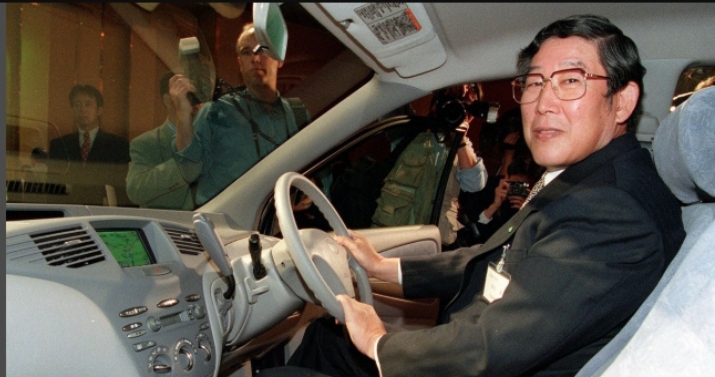
Former Toyota Motor Corporation President and Chairman, Hiroshi Okuda, one of the executives credited with transforming the Japanese automaker into a global powerhouse, has died at the age of 93.
Toyota confirmed his death on Wednesday, August 12, 2026, although the company did not immediately disclose the date or cause of death.
Okuda remains closely associated with one of the most significant periods in Toyota’s history. He took over as the company’s President in 1995 and became Chairman in 1999, remaining in the top leadership structure until 2006.
Unlike many of Toyota’s leaders at the time, Okuda was not a member of the Toyoda family, which founded the company. His appointment marked an important departure from Toyota’s long-standing leadership tradition.
Born in Mie Prefecture, Japan, in 1932, Okuda graduated from Hitotsubashi University in 1955 with a degree in business. He joined Toyota that same year and spent about 45 years with the company.
His career began in Toyota’s accounting department before he moved into senior management and became increasingly involved in the company’s international operations.
When he became President in 1995, Toyota was facing a challenging business environment. Japan’s economy was dealing with the aftermath of its asset-price bubble, while the strong yen was making Japanese exports more expensive overseas.
Okuda responded by pushing Toyota to increase production outside Japan instead of depending heavily on exports from domestic factories.
In 1996, he introduced a strategy known as “Vision 2005”, which sought to reduce Toyota’s dependence on exports, strengthen overseas manufacturing and improve the company’s competitiveness.
Under his leadership, Toyota significantly expanded its international presence, increasing production in major overseas markets and establishing a stronger manufacturing base outside Japan.
Perhaps Okuda’s most enduring contribution to the automobile industry was his support for hybrid technology.
At a time when electric and alternative-power vehicles were still considered commercially uncertain, Toyota was developing a petrol-electric vehicle that would eventually become one of the world’s most recognisable hybrid models.
The first-generation Toyota Prius was introduced in Japan in 1997. The vehicle combined a petrol engine with an electric motor and became a landmark in the development of mass-market hybrid vehicles.
Okuda strongly backed the Prius and pushed for the vehicle to reach consumers quickly. The model subsequently became a symbol of fuel-efficient motoring and helped establish Toyota as a leader in hybrid technology.
The success of the Prius proved significant as concerns over fuel consumption, emissions and energy security increased globally.
Okuda also supported other important Toyota products, including the RAV4, as the company sought to respond to changing consumer preferences and expand its product portfolio.
His leadership was also crucial to Toyota’s global expansion.
Rather than relying primarily on factories in Japan to supply international markets, Toyota increased production closer to its customers. The company expanded manufacturing operations in North America and Europe, strengthening its position in some of the world’s most competitive automobile markets.
The expansion eventually helped Toyota challenge established American manufacturers and move toward becoming the world’s largest automaker by vehicle sales.
Okuda’s influence extended beyond Toyota and the automobile industry.
He became Chairman of the Japan Federation of Employers’ Associations in 1999 and later became the first Chairman of the Japan Business Federation, commonly known as Keidanren, following the merger of Japan’s major business organisations in 2002.
He also chaired the Japan Automobile Manufacturers Association from 2000 to 2002 and served as an adviser to the Japanese government on economic matters.
As one of Japan’s most influential business leaders, Okuda regularly spoke about economic policy, corporate restructuring, employment and the need for Japanese companies to remain competitive internationally.
He was known for his outspoken personality and willingness to challenge established practices.
That approach was also evident in his relationship with Toyota’s founding family. During his tenure, Okuda argued that members of the Toyoda family should demonstrate their suitability for senior positions rather than automatically inherit leadership roles.
His approach helped reinforce a more performance-driven culture within the company at a time when Toyota was undergoing rapid international expansion.
Okuda was also known for his interest in martial arts and was a black belt holder. His energetic personality and willingness to speak frankly made him stand out among Japan’s traditionally reserved corporate executives.
He stepped down as Toyota Chairman in 2006, with Fujio Cho succeeding him. Okuda subsequently served as a senior adviser to the company.
By the time he left Toyota’s top leadership, the company had undergone a remarkable transformation. Its overseas operations had expanded significantly, its vehicle lineup had become more diverse and the Prius had established Toyota as a major force in hybrid technology.
The impact of those decisions remains visible today. Toyota continues to maintain a major global manufacturing network and has remained one of the world’s leading producers of hybrid vehicles.
The company confirmed Okuda’s death on Wednesday but did not immediately provide further details about the circumstances surrounding his passing or funeral arrangements.
His death marks the end of the life of a corporate leader who played a major role in shaping Toyota’s modern identity.
From taking charge of the company during a difficult period in Japan’s economy to championing the Prius and accelerating Toyota’s international expansion, Okuda left a lasting imprint on one of the world’s most important automobile manufacturers.
He was 93.