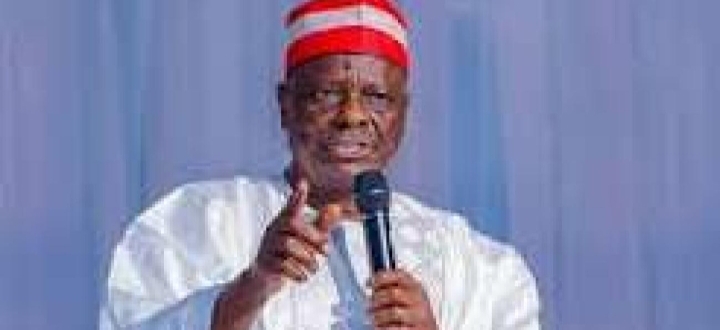
Former Kano State Governor and Vice Presidential Candidate of the Nigeria Democratic Congress (NDC), Rabiu Musa Kwankwaso, has criticised comments attributed to Islamic cleric, Sheikh Sani Yahaya Jingir, over his advocacy for Muslim-Muslim political tickets, saying the remarks are divisive and do not represent the position of the people of Kano.
Kwankwaso made his position known in a statement on Monday, August 10, 2026, following comments made by Jingir at an event in Kano over the weekend.
The former Governor said statements capable of deepening religious or political divisions should not be encouraged, particularly at a time when Nigeria is approaching another major electoral cycle.
According to Kwankwaso, religious and political leaders have a responsibility to promote unity rather than make statements that could further polarise citizens along religious lines.
He expressed concern that the remarks came from a prominent religious figure whose words could carry considerable influence among followers and members of the wider public.
Kwankwaso said the controversy was particularly significant because of the sensitivity surrounding religion and politics in Nigeria, where political competition ahead of the 2027 general elections is already intensifying.
The former Governor also sought to distance the people of Kano from the remarks, insisting that the comments should not be interpreted as representing the views of Kano residents.
He maintained that the people of the State should not be associated with rhetoric that could create division between Nigerians of different religious backgrounds.
Kwankwaso said political and religious leaders must use their positions responsibly and work towards strengthening peaceful coexistence, national unity and reconciliation.
His intervention came after Jingir reportedly intensified his advocacy for Muslim-Muslim political tickets during an event in Kano.
The cleric urged Muslims in the State to support political candidates who favour Muslim-Muslim tickets and encouraged eligible citizens to obtain their Permanent Voter Cards ahead of future elections.
Jingir also addressed criticism from Christians and members of other religious communities who have opposed the idea of Muslim-Muslim tickets.
In remarks that generated controversy, the cleric referred to Christians and other religious groups while questioning whether his campaign for a Muslim-Muslim ticket amounted to wrongdoing.
The comments have since attracted reactions from political figures and Christian leaders, with critics arguing that the language used could heighten religious tensions at a time when political parties are preparing for the 2027 elections.
Kwankwaso’s response places the controversy within the wider political debate over the role of religion in Nigeria’s electoral politics.
The issue of Muslim-Muslim tickets became particularly prominent during the 2023 presidential election after the All Progressives Congress fielded Bola Tinubu, a Muslim, alongside Kashim Shettima, also a Muslim.
The arrangement generated strong reactions across the country, particularly among Christian groups and political opponents who argued that Nigeria’s religious diversity should be reflected in political leadership.
Supporters of the arrangement, however, have maintained that competence, political representation and electoral choice should be the principal considerations in selecting candidates.
With the 2027 election approaching, the question of religious balancing is again becoming a major issue in political discussions.
Kwankwaso, who contested the 2023 presidential election on the platform of the New Nigeria Peoples Party (NNPP), remains a major political figure in Kano and the wider northern region.
His political influence in Kano has made his comments on sensitive national issues particularly significant as political realignments continue ahead of the next presidential election.
In his latest statement, Kwankwaso also turned his attention to the 2027 general elections, describing the poll as an opportunity for Nigerians to assess the performance of the current administration.
He said voters would have the chance to reward what they consider good governance while rejecting what they regard as poor performance.
Kwankwaso’s comments come amid growing political activity across the country as politicians, political parties and interest groups position themselves for the 2027 contest.
The former Governor urged Nigerians and their leaders to place national unity above political or religious interests.
He argued that Nigeria’s political future should not be shaped by statements capable of weakening the country’s sense of shared identity.
The former Governor’s intervention has also coincided with reactions from other prominent Nigerians and Christian organisations to Jingir’s remarks.
The Christian Association of Nigeria (CAN) in the 19 Northern States and the Federal Capital Territory has also condemned the use of the term “infidel” in the context of the cleric’s comments on Muslim-Muslim tickets.
Former Aviation Minister, Femi Fani-Kayode, also criticised the remarks, adding to the growing public debate surrounding the cleric’s position on religion and political leadership.
For Kwankwaso, however, the central concern is the potential effect of divisive rhetoric on Nigeria’s already delicate political and social environment.
He called on leaders across religious and political divides to recognise their responsibility to promote truth, unity and reconciliation.
The statement also reflects the increasingly competitive political atmosphere in Kano, a State widely regarded as one of the most influential political centres in northern Nigeria.
As parties and political actors begin to consolidate their positions ahead of 2027, debates over religion, political alliances and candidate selection are expected to remain prominent.
Kwankwaso concluded his statement with a prayer for Nigeria, calling for the country’s continued peace and progress.
His comments have therefore added a significant political voice to the growing debate over Jingir’s remarks, while also underscoring the sensitivity of religious issues as Nigeria moves closer to another general election.
The former Governor’s position is clear: political and religious differences should not be allowed to undermine national cohesion, and the people of Kano, he insists, should not be portrayed as endorsing statements that promote division.