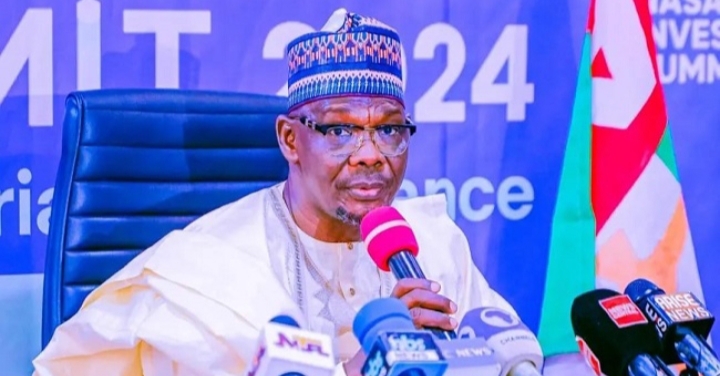
Nasarawa State Governor, Abdullahi Sule, has credited President Bola Ahmed Tinubu’s economic reforms with giving the State greater financial capacity to execute major infrastructure projects without resorting to bank borrowing.
Sule said Nasarawa’s monthly allocation from the Federation Account had increased significantly since the implementation of the Tinubu administration’s reforms, rising from an average of between ₦3.8 billion and ₦4.5 billion before 2023 to between ₦14 billion and ₦16 billion currently.
The Governor made the disclosure on Saturday, August 8, 2026, when he received members of the Renewed Hope Ambassadors Presidential Media Team at the Government House in Lafia, the Nasarawa State capital.
The delegation, led by Bayo Onanuga, Special Adviser to President Tinubu on Information and Strategy, was in the State as part of a project-verification tour across the North-Central geopolitical zone.
The inspection is designed to enable the delegation assess ongoing federal and state projects while examining how increased public resources are being deployed under the current administration.
Sule used the occasion to explain how the increase in funds available to Nasarawa had enabled his administration to undertake projects that, according to him, would have been difficult to finance under the previous revenue situation.
He attributed the improved financial position largely to the Federal Government’s decision to remove the petrol subsidy and implement foreign exchange reforms.
According to the Governor, the reforms released resources that had previously been committed to subsidy arrangements and other areas of Government expenditure, creating additional fiscal space for states.
Sule said the increased allocation had allowed Nasarawa to channel more resources into roads, bridges, drainage infrastructure, healthcare, education, agriculture and human capital development.
Among the projects he highlighted was the Mararaba dual flyover, which is being constructed at a reported cost of ₦16.7 billion.
He also listed the dualisation of Akwanga township, valued at ₦7.1 billion, as well as the Akwanga underpass, which is estimated at ₦6.6 billion.
Other projects mentioned by the Governor included the ₦5.6 billion Shendam Road dualisation, a ₦3.3 billion storm-water channel at Amba Bridge and the ₦11.4 billion Keffi flyover.
Taken together with other Government interventions, Sule said the State had so far committed about ₦90 billion to major projects.
He contrasted the current level of spending with the financial difficulties the State experienced in previous years.
The Governor recalled that in 2019, Nasarawa had struggled to secure a ₦5 billion bond to finance a market project, describing the situation as evidence of how limited the State’s financial capacity had previously been.
Sule therefore maintained that the scale of projects currently being undertaken would not have been possible without the additional revenue accruing to the State.
He repeatedly linked the increased financial capacity to the reforms introduced by the Tinubu administration and said the Federal Government deserved recognition for creating the conditions that enabled states to undertake larger development programmes.
The Governor also stressed that the projects were being implemented without the State taking bank loans.
He said the ability to finance major infrastructure from available resources represented a significant departure from the financial circumstances faced by Nasarawa in earlier years.
Beyond physical infrastructure, Sule pointed to investments in sectors intended to improve the long-term economic and social wellbeing of residents.
He highlighted vocational education, including a skills acquisition centre where residents are trained in 12 different trades.
According to the Governor, the investment in skills development is aimed at equipping young people and other residents with practical abilities that can improve their prospects for employment and entrepreneurship.
Healthcare was another area mentioned during the engagement.
Sule disclosed that a specialist hospital was under construction in Akwanga, adding that the State Government was expanding its investments in health infrastructure as part of its development programme.
Agriculture also featured prominently in the Governor’s presentation, with the State highlighting a 10,000-hectare rice farm as one of the projects being developed to strengthen agricultural production.
The Governor’s presentation came against the backdrop of the wider Renewed Hope National Media Tour, which has taken Government officials, journalists and members of the Renewed Hope Ambassadors to different parts of the country to inspect major projects.
Previous phases of the tour have included inspections in several geopolitical zones. In July, for instance, the Presidential Media Team and Renewed Hope Ambassadors inspected projects in Kogi State, including road, health and market infrastructure.
The team had also undertaken inspections in the South-East, where projects in states including Ebonyi, Enugu, Abia and Imo were examined. Reports from those visits similarly focused on the relationship between increased allocations to sub-national governments and the ability of states to undertake major infrastructure projects.
Speaking during the Nasarawa visit, Onanuga said the purpose of the exercise was to verify on the ground how resources made available through the Federal Government’s reforms were being utilised.
He also described Nasarawa as an emerging industrial hub under Sule’s administration.
The visit therefore provided an opportunity for the State Government to showcase its development projects while explaining the financial strategy behind their execution.
Sule’s remarks also placed the debate over Tinubu’s economic policies within the context of state-level finances.
The removal of the petrol subsidy and changes in foreign exchange policy have remained among the most significant economic measures introduced by the Tinubu administration. The Federal Government has consistently argued that the reforms were necessary to reduce fiscal pressures and redirect public resources towards development.
State governments have subsequently reported higher revenues from federal allocations, although the increased revenue has come amid broader economic challenges, including elevated living costs and inflation.
For Nasarawa, however, Sule argued that the additional funds have created room for the Government to pursue infrastructure projects on a scale that was previously difficult to contemplate.
The Governor’s position is that the combination of higher allocations and prudent spending has allowed the State to undertake major capital projects without accumulating new bank debt.
He said the ongoing projects represented tangible evidence of what he described as the benefits of the Federal Government’s fiscal reforms.
With the Renewed Hope Ambassadors and Presidential Media Team continuing their nationwide verification exercise, the Nasarawa projects are now part of the broader picture being presented by the Federal Government and participating state administrations as evidence of increased public investment under the Tinubu presidency.
The Nasarawa Government’s ₦90 billion figure, as presented by Sule, covers several major infrastructure initiatives as well as other development interventions being implemented by the State.
The Governor maintained that the State’s ability to undertake such projects without borrowing marked a significant improvement from the financial constraints it faced in previous years.
For the Sule administration, the projects are expected to improve transportation, strengthen economic activity, expand access to healthcare and skills development, and support agriculture across the State.
The Governor consequently urged the visiting team and Nigerians generally to give President Tinubu credit for the reforms, arguing that the increased fiscal space has enabled Nasarawa to pursue projects that would previously have been beyond its immediate financial capacity.