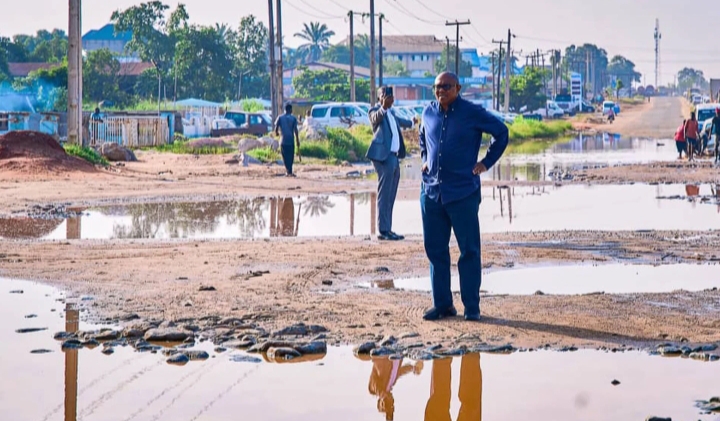
President Bola Tinubu’s recent position on avoiding unnecessary flyover projects has received unexpected backing from the presidential candidate of the Nigerian Democratic Congress (NDC), Peter Obi, who says governments across Nigeria should focus on repairing neglected infrastructure instead of spending public funds on expensive new developments with little immediate value.
Obi, while reacting to the President’s remarks, argued that the country can no longer afford to prioritise prestige projects when many existing roads and other public facilities have fallen into disrepair. He maintained that the rehabilitation and completion of existing infrastructure should always take precedence over launching fresh projects that may consume huge resources without delivering urgent benefits to citizens.
The former Anambra State Governor also used the opportunity to call on federal, state and local governments to abandon what he described as “white-elephant projects,” insisting that limited public funds should be invested where they will have the greatest impact on the lives of Nigerians.
In a statement released on Saturday, Obi said he has consistently maintained the same position throughout his years in public service, stressing that governments should complete and restore existing infrastructure before embarking on new capital projects.
According to him, public resources are becoming increasingly scarce, making it even more important for governments to channel available funds into projects capable of improving transportation, boosting economic activities and enhancing the welfare of ordinary Nigerians.
Obi noted that President Tinubu’s recent comments reflected a principle he has repeatedly advocated over the years.
He said the President’s position reinforces the argument that governance should revolve around addressing the most pressing needs of citizens instead of pursuing projects designed mainly for prestige or political visibility.
“The President is, in essence, saying what I have always maintained: government must prioritise projects that directly address the immediate needs of the people,” Obi stated.
Despite welcoming the President’s position, the former Governor urged the Federal Government to ensure that the same principle guides its own infrastructure policies and spending decisions.
He cautioned against embarking on ambitious projects that may eventually become financial burdens while several strategic national assets continue to deteriorate due to years of neglect.
Obi expressed concern over the condition of many federal highways across the country, describing several of them as dangerous death traps that require immediate intervention.
According to him, numerous roads connecting major commercial centres with agricultural communities have deteriorated significantly, making transportation difficult, increasing the cost of moving goods and posing serious risks to motorists and other road users.
He argued that rehabilitating these highways should receive greater priority than initiating costly projects that may not produce immediate benefits for Nigerians.
The NDC presidential candidate further stressed that Nigeria’s current fiscal realities demand prudent management of public finances.
He said governments at every level must embrace responsible spending by concentrating available resources on completing abandoned and ongoing projects rather than introducing fresh ones that could eventually be abandoned due to inadequate funding.
Obi maintained that completing existing infrastructure projects would deliver better value for taxpayers and produce more immediate economic and social benefits than starting entirely new projects without sufficient planning or financial capacity.
Reflecting on his years as Governor of Anambra State, Obi recalled that his administration deliberately focused on completing viable projects inherited from previous governments before introducing new ones.
According to him, that approach ensured continuity in governance while preventing public resources from being wasted on abandoned developments.
He insisted that governance should not be viewed as an opportunity for successive administrations to discard projects initiated by their predecessors simply because of political differences.
Instead, he argued that every administration has a responsibility to preserve worthwhile investments already made with public funds by ensuring that viable projects are completed and put into use.
Obi said true leadership is demonstrated not by the number of projects initiated during an administration but by the willingness to complete projects that genuinely improve the lives of citizens.
He emphasised that governments should make decisions based on public interest rather than political considerations or the desire to commission new projects.
According to him, fixing damaged infrastructure, completing ongoing projects and investing scarce resources in areas with the highest public value remain the hallmarks of responsible governance.
“Leadership is about making the right choices: fixing what is broken, completing what has already been started, and investing limited public resources where they will have the greatest impact on the greatest number of people,” Obi stated.
His comments come amid increasing national conversations about infrastructure spending, public debt and the need for governments to maximise limited financial resources.
The debate has also intensified as many Nigerians continue to express concerns over the poor condition of major highways, deteriorating public infrastructure and the growing cost of executing large-scale capital projects.
Obi’s endorsement of the President’s remarks on unnecessary flyovers represents a rare point of agreement between two leading political figures from different parties on a key governance issue.
However, while supporting Tinubu’s position in principle, he maintained that the Federal Government must match its words with action by directing greater attention and resources toward restoring deteriorating roads and other critical infrastructure across the country.
He reiterated that governments should avoid projects that offer limited immediate value while urgent infrastructure needs remain unattended.
For Obi, Nigeria’s development challenges require practical choices centred on repairing what already exists, completing unfinished projects and ensuring that every naira of public money delivers measurable benefits to the greatest number of citizens.
He concluded that sustainable governance depends on prudent decision-making, continuity in public projects and a commitment to investing scarce resources where they will produce the most meaningful impact on national development.