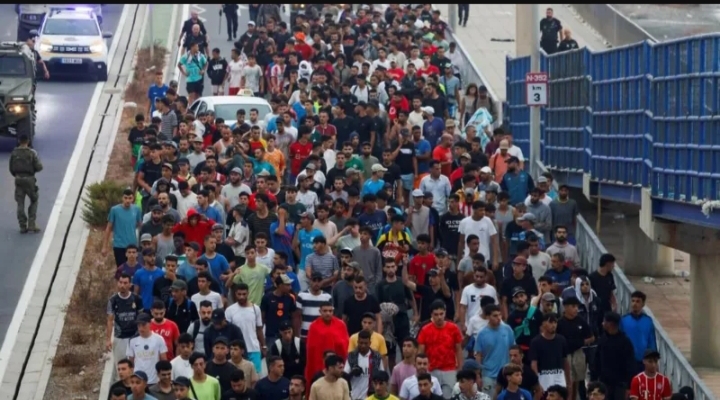
The European Union is preparing for high-level emergency discussions after an unprecedented wave of migrants crossed from Morocco into the Spanish enclave of Ceuta, triggering political tensions across Europe and renewed debate over border security, migration management and cooperation among member states.
The extraordinary movement of people into the North African territory has become one of the biggest migration challenges the bloc has faced in recent years. While Spanish authorities say the immediate situation has largely been brought under control, the political fallout continues to grow as several European governments push for tougher measures to protect the EU’s external borders.
The emergency meeting, scheduled for Tuesday, follows growing concern among EU leaders over the implications of the mass crossings and the possibility of similar incidents occurring elsewhere along Europe’s borders.
Twenty-Two EU Countries Demand Coordinated Response
Ahead of the meeting, 22 European Union member states jointly urged the bloc’s leadership to strengthen cooperation on border protection and develop a unified response to the latest migration crisis.
In their communication to European Council President, António Costa, European Commission President, Ursula von der Leyen and Irish Taoiseach Michael Martin, whose country currently holds the rotating Presidency of the Council of the European Union, the countries warned that irregular migration on such a scale could undermine confidence in the EU’s common migration framework.
The governments also expressed concern that successful large-scale illegal crossings could encourage further attempts by migrants and trafficking networks, creating additional pressure on Europe’s external frontiers.
The coordinated appeal reflects growing anxiety among European capitals about maintaining both humanitarian obligations and effective border control.
Spain Rejects Criticism From Some European Governments
Spanish Prime Minister, Pedro Sánchez has defended his government’s handling of the crisis, insisting that security forces acted swiftly to restore order after the influx into Ceuta.
According to Sánchez, Spanish authorities regained effective control of the border within 48 hours and successfully prevented unauthorised movement from Ceuta into mainland Europe.
The Spanish leader also voiced disappointment with the response of some European governments, arguing that instead of showing solidarity, they chose to criticise Madrid during one of its most challenging border situations in recent years.
He accused some political leaders of relying on misinformation, prejudice or domestic political considerations instead of acknowledging Spain’s efforts to stabilise the situation.
Sánchez also emphasised that Ceuta is not part of the Schengen Area, despite being Spanish territory, making some criticisms regarding Europe’s passport-free travel zone inaccurate.
Italy Suspends Schengen Arrangement With Spain
One of the strongest reactions came from Italy, where Prime Minister Giorgia Meloni announced a temporary suspension of Italy’s Schengen arrangements with Spain for one month.
The move sparked fresh debate across Europe about whether internal border controls should be reintroduced whenever external migration pressures increase significantly.
Other countries, including Finland, France and Portugal, indicated they were either examining or considering additional border checks in response to the developments.
Danish Prime Minister, Mette Frederiksen, also urged European leaders to consider every available option, including reviewing aspects of Schengen cooperation if necessary.
The differing reactions have exposed divisions within the European Union over how migration challenges should be managed while preserving the bloc’s principle of free movement.
Spanish Authorities Say Situation Is Stabilising
Spain’s Interior Minister, Fernando Grande-Marlaska, said authorities have made substantial progress in restoring normalcy in Ceuta.
According to him, the overwhelming majority of migrants who entered the enclave during the mass crossing have already departed, while commercial activities and businesses have resumed operations.
He also disclosed that Spanish authorities are working on additional physical measures, including inflatable maritime barriers, aimed at reducing illegal sea crossings into the enclave.
Officials believe these measures, alongside increased surveillance, could help prevent similar incidents in the future.
Death Toll Raises Humanitarian Concerns
Although authorities report that most migrants have now left Ceuta, the humanitarian consequences of the incident remain significant.
Officials say at least 67 people lost their lives during the surge in crossings, highlighting the dangers associated with irregular migration routes across the Mediterranean and surrounding coastal waters.
Human rights organisations and humanitarian groups continue to stress the need for measures that protect lives while addressing the root causes driving migration from North Africa.
EU Leadership Calls for Respect of Border Rules
European Commission President, Ursula von der Leyen, described the scenes witnessed in Ceuta as unacceptable, emphasising that entry into the European Union must take place according to established legal procedures.
Several European leaders echoed similar views, insisting that protecting the bloc’s external borders remains essential to maintaining confidence in the EU’s migration system.
German Chancellor, Friedrich Merz, also urged Morocco to cooperate by accepting the return of migrants who entered Spain illegally.
Meanwhile, British Prime Minister, Andy Burnham, said he had spoken with Sánchez and indicated that the United Kingdom was prepared to provide assistance where appropriate despite no longer being an EU member.
Morocco Remains Central to the Crisis
Ceuta occupies a unique geographical position on the northern coast of Africa but forms part of Spain, making it one of only two European Union land borders with the African continent alongside Melilla.
Because of its location, the enclave has long attracted migrants seeking entry into Europe.
Many attempt the dangerous journey by swimming around coastal barriers or using other irregular routes, particularly during the summer months when weather conditions are generally more favourable.
The latest surge has once again highlighted the importance of cooperation between Spain and Morocco in managing migration flows.
Morocco has also experienced domestic social and economic pressures in recent years, with younger citizens staging protests demanding better employment opportunities and improved public services.
Ceuta’s Long History as a Migration Flashpoint
Although this year’s crossings are exceptional in scale, Ceuta has experienced repeated migration crises over the years.
The enclave became the focus of international attention in 2021 when approximately 8,000 migrants entered within a matter of days, straining diplomatic relations between Spain and Morocco.
The latest developments have revived memories of that earlier crisis while reinforcing concerns about the ability of European governments to respond collectively to sudden migration emergencies.
Spain’s Immigration Policy Under Scrutiny
Spain has generally maintained a comparatively open approach to immigration.
Earlier this year, the Spanish government approved plans to regularise the status of around 500,000 undocumented migrants, enabling them to legally join the country’s workforce.
Supporters argue the measure addresses labour shortages while promoting integration, whereas critics contend that generous immigration policies could encourage further irregular migration.
The contrasting viewpoints have become even more prominent following the events in Ceuta.
Emergency Meeting Expected to Shape Future Policy
Attention is now turning to Tuesday’s emergency EU meeting, where leaders are expected to discuss immediate border security measures, cooperation with Morocco and broader reforms to the bloc’s migration framework.
The outcome could influence future European migration policy, determine how member states coordinate during sudden border emergencies and shape relations with neighbouring countries involved in migration management.
For Spain, the priority remains ensuring stability in Ceuta while preserving support from its European partners. For the wider European Union, the challenge will be balancing humanitarian responsibilities with stronger external border controls as migration continues to test the unity of the 27-member bloc.