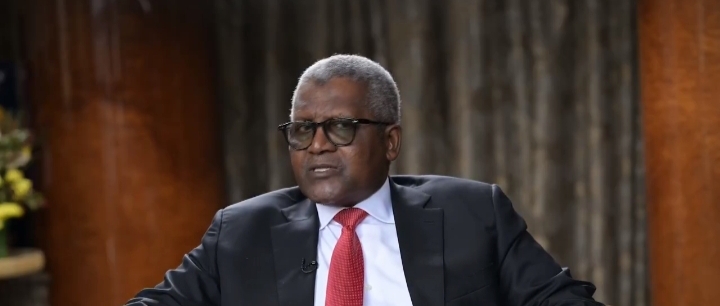
President of Dangote Industries Limited, Aliko Dangote, has said the Dangote Petroleum Refinery is targeting up to 10 million shareholders across Africa, with priority to be given to small retail investors as the company seeks to broaden ownership of the multibillion-dollar facility.
Dangote made the remarks in an interview as the refinery’s landmark Initial Public Offering (IPO) opened on the Nigerian Exchange, describing the offer as a “People’s IPO” designed to give ordinary Africans an opportunity to own a stake in one of the continent’s largest industrial projects.
According to the billionaire businessman, the objective of the public offer goes beyond raising capital. He said the company’s strong cash flow and previous fundraising through bonds and private placements meant that generating money was not the principal reason for taking the refinery to the public market.
Instead, Dangote said the central ambition was to spread ownership among millions of ordinary people.
The refinery’s IPO involves 4.1 billion ordinary shares priced at ₦525 each, with the offer seeking to raise approximately ₦2.15 trillion if fully subscribed. Investors can subscribe for a minimum of 10 shares, requiring an initial investment of ₦5,250.
Dangote said the company deliberately limited the size of the offer because its intention was to accommodate a broad base of investors rather than concentrate the shares in the hands of a few wealthy individuals or institutions.
“It’s not really about raising money. It’s about getting our own Africans generally to be part and parcel of this,” Dangote said.
He explained that if raising money had been the overriding objective, the company could have offered a substantially larger percentage of the refinery.
“If we want to raise money, we know how to raise,” he said, adding that the company could have offered about 20 per cent of the business if capital mobilisation had been its main concern.
Small Investors To Get Priority
In the interview, Dangote made it clear that smaller investors would receive special consideration during the allocation process.
He said the company wanted ordinary Nigerians and other African investors to have a genuine opportunity to become shareholders, rather than allowing investors seeking large blocks of shares to dominate the offer.
“We are going to prioritise small shareholders,” Dangote said.
He explained that smaller applications would be considered first before larger block applications, reflecting the company’s stated intention to make the IPO widely accessible.
However, he clarified that larger investors would not necessarily be excluded.
“Just apply and pay. If you are lucky, you might even get whatever that you are looking for,” he said.
The approach is consistent with Dangote’s earlier description of the transaction as an effort to democratise ownership of the refinery.
He said he was prepared to reduce his own stake further if necessary to accommodate stronger-than-expected demand from retail investors.
“I don’t mind to be diluted as much as possible because I want people to actually be part of this good journey,” Dangote said.
The billionaire currently retains a dominant position in the refinery, but said he was willing to give up more shares if demand warranted a larger allocation.
“We’ll give up more shares,” he said, adding that the company could increase the number of shares allocated to investors if demand remained exceptionally high.
Dangote Wants 70,000 Shareholders At AGM
One of the most striking revelations from the interview was Dangote’s vision for the refinery’s future annual general meetings.
Rather than holding shareholder meetings in hotels, as is common with many Nigerian companies, he said the scale of ownership he envisages could eventually require stadiums.
Dangote said the refinery could have as many as 70,000 people attending its annual general meeting.
“I think we are looking at now not having annual general meeting in the hotel like what we have been doing in other companies, no,” he said.
“This one, we’ll be stadium. I’m sure 70,000 people will gather for that annual general meeting.”
For Dangote, however, the large shareholder base would not simply be about numbers. He said shareholders should actively monitor the company and demand accountability from its management.
“We’ll encourage them to come and tell us how good we are running their company,” he said.
“If we are not running it well, they should blast us and tell us what to do.”
The comments point to a model of corporate ownership in which ordinary investors would not merely hold shares for financial returns but would also have a greater sense of participation in the company.
Dangote said this was part of his broader ambition to ensure that the refinery no longer belongs in the public imagination to one businessman or a small group of investors.
“This business does not belong to Mr. Dangote; it belongs to all of us,” he said.
Aiming For 10 Million Investors Across Africa
The 10 million-shareholder target represents an unusually ambitious attempt to expand retail participation in Nigeria’s capital market.
Dangote said the target would cover investors across Africa and potentially other parts of the world, with the refinery positioned as a long-term wealth-building opportunity.
He said he wanted the investment to create a situation where ordinary salary earners could gradually build wealth through ownership of shares in major African companies.
Dangote previously likened the ambition to the ownership structures associated with global companies such as Amazon and Coca-Cola, where investors can hold shares for years and potentially see substantial increases in their value.
The businessman has also urged investors to view the refinery shares as a long-term investment rather than an opportunity for quick trading.
In the interview, he said an investment of around ₦100,000 could potentially become worth ₦1 million within one or two years if the company’s shares appreciate significantly, although such an outcome is a projection rather than a guaranteed return. He also said the refinery could eventually generate dollar-denominated dividends, which he argued could provide a hedge for investors against naira depreciation.
Refinery IPO Opens Amid Strong Demand
The public offer officially opened on September 14, 2026, amid significant interest from investors.
Reports indicated that more than $7 million, equivalent to about ₦10 billion, was committed within the first hour of the IPO opening, highlighting the early appetite for shares in the refinery.
The offering is expected to become Africa’s largest IPO and marks a major transition for the Dangote Refinery from private ownership towards broader public participation.
The refinery, which has a capacity of about 700,000 barrels per day, began operations in 2024 and has become a major component of Nigeria’s effort to reduce dependence on imported refined petroleum products.
Dangote has said the company’s expansion plans will require continued investment, with the refinery expected to increase its capacity substantially in the coming years.
For the businessman, however, the IPO represents more than a fundraising exercise. It is an attempt to create a mass shareholder base around one of Africa’s biggest industrial investments.
With the company targeting 10 million shareholders, prioritising smaller investors and even contemplating stadium-sized annual meetings, Dangote is betting that the refinery can become not only a major energy asset but also a widely owned African corporation.
His message to potential investors is therefore clear: the IPO is intended to put a portion of the refinery’s future in the hands of ordinary people while creating a shareholder base large enough to demand accountability from management.
As Dangote puts it, the ultimate goal is to ensure that the benefits of the refinery’s growth are not restricted to its founder and existing investors, but are distributed across a much broader community of shareholders in Nigeria, Africa and beyond.