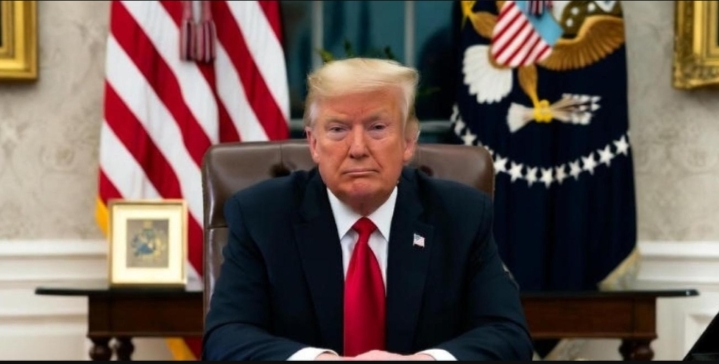
U.S. President, Donald Trump, has launched a fresh attack on the International Criminal Court (ICC), calling on countries that belong to the tribunal to withdraw from it and accusing the institution of acting beyond its authority.
Trump made the remarks on Tuesday, September 22, 2026, during his address to the 81st United Nations General Assembly in New York, where he also issued a stark warning to Iran and said he was weighing whether to pursue a negotiated settlement with Tehran or take further military action.
The speech placed international justice, Iran’s nuclear programme and U.S. military power at the centre of Trump’s address to world leaders.
Speaking about the ICC, Trump said the United States would not permit American military personnel to face what he described as “show trials” before an “anti-American tribunal” that, in his view, has no jurisdiction over the United States.
“I call on all nations that are members of the ICC to officially resign from this rogue institution immediately,” Trump said.
He also described the court as “out of control” and referred to it as an “evil group of people.”
Trump’s comments were directed at an institution that currently has 125 States Parties to the Rome Statute. Ukraine became the 125th State Party in January 2025.
The United States, however, is not a member of the ICC and has never ratified the Rome Statute. Israel is also outside the treaty framework, as are Russia and China.
Why Trump Is Targeting The ICC
Trump’s latest comments are part of a broader dispute between his administration and the international court.
The confrontation intensified after the ICC issued arrest warrants for Israeli Prime Minister, Benjamin Netanyahu and then-Defence Minister, Yoav Gallant on November 21, 2024.
The court said its Pre-Trial Chamber had found reasonable grounds to believe that Netanyahu and Gallant bore criminal responsibility for alleged war crimes and crimes against humanity connected to the situation in Gaza. The allegations included starvation as a method of warfare, intentionally directing attacks against civilians, murder, persecution and other inhumane acts.
The Israeli Government has challenged the court’s jurisdiction, while the ICC has maintained that it has jurisdiction over the situation in Palestine under the Rome Statute.
The United States Government has strongly opposed the warrants.
In February 2025, Trump signed an executive order imposing sanctions related to the ICC. The White House said at the time that the court had taken what it regarded as illegitimate actions against the United States and Israel, including issuing the warrants for Netanyahu and Gallant. The order authorised measures including blocking property and restricting entry into the United States for certain ICC officials and others covered by the sanctions.
The White House’s position is that the ICC cannot exercise jurisdiction over American or Israeli nationals where the relevant countries have not accepted the court’s jurisdiction.
The ICC, meanwhile, continues to maintain its judicial proceedings and investigations under the authority of the Rome Statute.
The dispute has therefore developed into a broader argument over national sovereignty, international criminal jurisdiction and the extent to which an international court can investigate alleged crimes involving nationals of countries that are not parties to the Rome Statute.
Trump Issues Fresh Warning To Iran
The ICC attack was only one part of Trump’s address.
The U.S. President also delivered a particularly forceful warning to Iran, saying he faced a choice between reaching an agreement with Tehran and taking much more severe military action.
Trump said he was considering whether a deal could allow Iran to rebuild and become a stronger country or whether the United States would instead take action that could “annihilate the Islamic Republic.”
He also used the phrase “drive them into hell” while discussing the alternative to a diplomatic agreement.
The comments came against the backdrop of the continuing confrontation between Washington and Tehran and Trump’s repeated insistence that Iran must not be allowed to acquire a nuclear weapon.
It was reported that Trump used the UN speech to warn that Iran could face further military action if a peace agreement is not reached, while also calling for international economic pressure on Tehran.
The remarks were delivered as world leaders gathered in New York for the annual General Assembly, with the Middle East conflict remaining one of the major issues dominating international diplomacy.
US-Iran Conflict Dominates Trump’s Foreign Policy Message
Trump used the address to defend his administration’s military actions and broader foreign-policy approach.
He argued that the military campaign against Iran had prevented Tehran from obtaining a nuclear weapon and maintained that the United States would not allow Iran to develop such a capability.
According to a reporting from the General Assembly, Trump also defended his decision to initiate military action against Iran, while saying that a settlement could still be reached.
Trump’s remarks came at a particularly sensitive moment because any further escalation involving the United States and Iran could have consequences well beyond the two countries, including for energy markets, regional security and diplomatic relations across the Middle East.
He also called on other countries to increase economic pressure on Iran, adding another dimension to Washington’s effort to influence Tehran through both diplomacy and sanctions.
ICC Dispute Reflects Wider U.S. Tension With International Institutions
Trump’s criticism of the ICC also fits into a longer pattern of U.S. opposition to certain international institutions and agreements.
During his first presidency, Trump criticised the ICC and said the United States did not recognise its authority. In a 2018 address to the UN General Assembly, he said the United States would not support the court and argued that it threatened national sovereignty.
His second administration has continued that approach.
In February 2025, the White House ordered sanctions against individuals connected with ICC actions involving the United States and its allies. The administration said it viewed potential ICC investigations or prosecutions involving protected U.S. personnel as a threat to American national security and foreign-policy interests.
The latest UN speech therefore represents an escalation in the political rhetoric surrounding the court rather than the beginning of the dispute.
Trump’s appeal for ICC member states to leave the institution would require individual countries to make their own decisions under the Rome Statute. Membership is governed by the treaty and withdrawal involves a formal process rather than an immediate departure based solely on a political declaration.
International Debate Over The ICC Continues
The ICC was established under the Rome Statute to prosecute individuals accused of genocide, war crimes, crimes against humanity and the crime of aggression in circumstances where the court has jurisdiction.
Its supporters argue that the institution provides an international mechanism for pursuing accountability when national systems are unable or unwilling to investigate and prosecute serious international crimes.
Its critics, including the Trump administration, argue that the court can intrude on national sovereignty and exercise jurisdiction beyond what countries such as the United States have accepted.
The disagreement over Netanyahu and Gallant has brought those competing positions into sharp focus.
The ICC’s November 2024 decision stated that Israel’s acceptance of the court’s jurisdiction was not required for the court to exercise jurisdiction in the Palestine situation because of the territorial basis of the court’s jurisdiction. Israel has disputed that position.
Trump’s latest remarks place that legal disagreement directly before the wider international community.
What Happens Next
Trump’s call for ICC members to withdraw does not itself remove any country from the court.
Each member state would have to decide whether to remain a party to the Rome Statute or begin the treaty’s withdrawal process.
The speech also does not by itself determine the future of the ICC’s cases involving Israeli officials or other individuals. Those matters remain subject to the court’s judicial procedures.
At the same time, Trump’s warning to Iran adds another layer of uncertainty to an already tense international environment.
For the United States, the speech reaffirmed Trump’s preference for negotiations backed by the threat of military force, while his attack on the ICC demonstrated that his administration remains opposed to the court’s jurisdiction over Americans and certain U.S. allies.
For the international community, the two issues raise separate but interconnected questions: how far international institutions should be able to exercise authority over states and individuals, and how much military pressure can be applied in pursuit of diplomatic and security objectives.
Trump’s September 22 address therefore placed the United States’ opposition to the ICC and its confrontation with Iran at the centre of his message to the United Nations, setting the stage for further diplomatic and legal disputes in the months ahead.