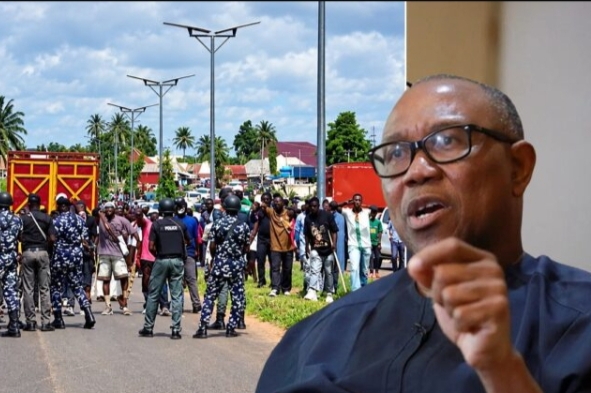
The Benue State Commissioner of Police, Cletus Nwadiogbu, has clarified that the Nigerian Democratic Congress (NDC) never instructed him to forward a letter notifying him of Peter Obi’s planned visit to Governor Hyacinth Alia.
Nwadiogbu said the letter was handed to him by members of the NDC who visited his office to inform the Police Command about Obi’s arrival, adding that the purpose of the notification, as presented to him, was to enable the police to make adequate security arrangements.
The clarification comes amid the controversy surrounding the disruption of Obi’s movement in Benue State on Tuesday, September 8, when a group of youths reportedly blocked his convoy along the Makurdi-Gboko Federal Highway.
Speaking in an interview on Thursday, September 10, Nwadiogbu gave an account of how the Police Command was informed about the visit and the security measures put in place ahead of Obi’s arrival.
According to the Commissioner, the NDC initially contacted his Police Public Relations Officer (PPRO) to indicate that members of the Party wanted to meet him.
He said the delegation was expected to arrive at about 3:00 p.m. but eventually reached his office around 5:30 p.m., when he and other officers were already preparing to leave.
Nwadiogbu explained that the delegation presented him with a letter during the meeting and informed him that Obi, the Party’s presidential candidate, would arrive in Benue by 8:00 a.m. the following day.
The Commissioner said he immediately raised concerns about the short notice, particularly because police personnel were already deployed across the State for various duties.
He explained that the Police Command, like other formations across the country, was operating with limited manpower and therefore needed sufficient time to organise personnel for additional security assignments.
The NDC representatives, however, reportedly explained that Obi was not coming into the State primarily for a campaign rally but for a visit and that only a small number of officers would be required.
Nwadiogbu said he decided to go beyond the limited security request by providing a larger police escort for the former Anambra State Governor.
Rather than assigning only a few officers, he said he deployed three patrol teams, with the Assistant Commissioner of Police in charge of Operations leading the security arrangement.
“I’d not give a VIP that few men. I am going to make sure I provide three patrol teams with full complements, and that was exactly what I did,” he said.
The Commissioner stressed that the police deployment was intended to protect Obi and ensure the safety of everyone involved in the movement.
‘They Never Told Me To Transmit The Letter’
Nwadiogbu specifically addressed the question of whether the NDC expected him to transmit its notification letter to Governor Alia.
He said that was never communicated to him by the delegation.
According to the Police Commissioner, the NDC members came to his office to inform the Command about Obi’s planned movement, with the information understood to be primarily for security coordination.
“To the issue of transmitting the letter to the Governor, they never told me to transmit to anybody,” Nwadiogbu said.
He added that he assumed the political party had already handled other necessary aspects of the visit and that his responsibility was to ensure that the police provided security.
The Commissioner’s comments are significant because the issue of whether the Benue State Government was formally notified of Obi’s visit has become one of the major points of disagreement following the incident.
The State Government had earlier maintained that adequate protocol was not followed ahead of the visit.
Benue Commissioner for Information, Solomon Iorpev, had argued that a high-profile visitor such as a former Governor and presidential candidate ought to formally notify the State Government, particularly because the Government has responsibility for security within the State.
The Police Commissioner’s account, however, establishes that the Police Command was aware of Obi’s planned arrival and had made specific security arrangements before the convoy left for Yelwata.
Obi’s Convoy Blocked On Makurdi-Gboko Road
Despite the police preparations, Obi’s convoy encountered a group of youths who blocked the road as he travelled towards Yelwata in Guma Local Government Area.
Obi had planned to visit the community to sympathise with residents and families affected by the deadly June 2025 attack in Yelwata.
The confrontation prevented the former Anambra Governor from reaching his destination. Police subsequently escorted him back to the airport rather than attempting to force the convoy through the blockade.
The police have maintained that the decision was tactical and intended to prevent the situation from escalating into violence.
The Command has since arrested 46 suspects allegedly linked to the obstruction. Nwadiogbu said investigations were continuing and that the police were also pursuing other individuals believed to have played key roles in the incident.
Political Tension Mounts
The incident has generated reactions across the political space, with the NDC and several opposition figures condemning the blockade.
Some political actors have alleged that the incident was politically motivated, although the police have not linked the suspects arrested to any political party or organisation. The Benue State Government has also denied any involvement in the incident.
Obi himself condemned what he described as “rascality” and called for greater accountability and protection of citizens’ rights.
The controversy has also revived memories of another dispute involving Obi’s visit to Benue in April 2025.
During that visit, his planned engagements with nursing students and internally displaced persons in Makurdi and Gboko were disrupted after the State Government issued a notice concerning “unscheduled visits.” Obi eventually abandoned the planned engagements and redirected his trip to Plateau State.
The latest incident therefore represents the second major disruption involving Obi’s movement in Benue within roughly 18 months.
For the police, however, the immediate focus is now on establishing what led to Tuesday’s blockade and identifying those responsible.
With 46 suspects already arrested and further investigations ongoing, attention is expected to shift from the people who physically blocked the convoy to the wider circumstances surrounding the incident.
The police have maintained that their priority is to preserve public safety and prevent political disagreements from degenerating into violence, particularly as political activities intensify ahead of the 2027 elections.
Nwadiogbu’s latest clarification also adds another dimension to the dispute: while questions remain over whether the State Government was formally notified, the Police Command insists that it was informed of Obi’s visit and took concrete steps to provide security for the NDC presidential candidate.
That distinction could become central to the continuing debate over who knew about Obi’s visit, what protocols were followed and who should ultimately be held responsible for the disruption of his movement in Benue.