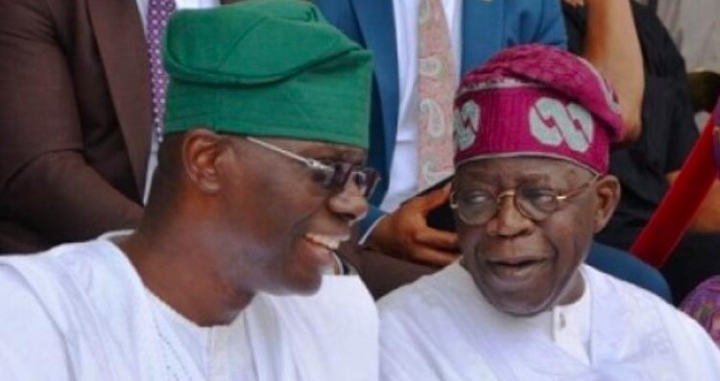
Lagos State Governor, Babajide Sanwo-Olu, has said the All Progressives Congress (APC) can lose an election under President Bola Ahmed Tinubu without the country’s democratic system being threatened.
Sanwo-Olu made the remark while speaking at the seventh annual lecture organised by Freedom Online on Thursday, September 3, 2026, at the Sheraton Hotel in Ikeja, Lagos.
The lecture, which focused on “2027 Elections: Economy, Security and Nigeria’s Future,” brought together political leaders, media professionals and other stakeholders to discuss Nigeria’s democratic development and the challenges ahead of the 2027 general elections.
Sanwo-Olu used the recent Osun State governorship election to highlight what he described as evidence of growing democratic maturity under the Tinubu administration.
The Governor pointed to the August 15 Osun governorship election, where the APC candidate, Bola Oyebamiji, lost to the incumbent Governor, Ademola Adeleke, who contested under another political platform.
Adeleke won the election by more than 60,000 votes, defeating the candidate of the governing party in a state located in the South-West, the region where Tinubu has traditionally enjoyed considerable political influence.
For Sanwo-Olu, the outcome was significant not simply because of the margin of victory but because of how the Federal Government responded to the result.
He noted that Tinubu congratulated Adeleke after the election rather than challenging the outcome, and subsequently met the Governor at the Presidential Villa in Abuja.
Sanwo-Olu argued that such a response represented an important departure from Nigeria’s past political culture, when the influence of the Federal Government was often associated with the electoral fortunes of the Party in power.
“There was a time in this country when ‘federal might’ was a phrase that a ruling party used without irony,” the Governor said.
He added that the APC’s defeat in Osun demonstrated that an opposition candidate could win a state election without the democratic process collapsing.
“Under this President, the ruling party can lose a state in the South-West in an election year, and the sky does not fall. That is what a maturing democracy looks like,” Sanwo-Olu said.
The Lagos Governor described Tinubu as a “lifelong democrat” and said the President wanted to leave behind stronger democratic institutions than those he inherited.
According to him, the significance of the Osun election extends beyond the immediate political contest because it offers Nigerians an opportunity to assess whether democratic institutions are becoming strong enough to withstand electoral victories and defeats.
Sanwo-Olu said the 2027 elections would provide another major test of the country’s democratic institutions, particularly the Independent National Electoral Commission (INEC), political parties, security agencies, the media and voters.
Sanwo-Olu Urges INEC To Prepare For 2027
While praising improvements in Nigeria’s electoral system, Sanwo-Olu stressed that more work must be done before the 2027 general elections.
He said INEC must be adequately prepared to conduct elections across the country and ensure that voters have confidence in the process.
“INEC must be ready in every polling unit on the 16th of January and again on the 6th of February, and each of us has a duty to help it be ready,” he said.
The Governor also referenced electoral reforms and the growing use of technology as developments that have helped improve the conduct of elections in Nigeria.
He said the country had made progress in strengthening its electoral framework, but warned that technological improvements alone would not guarantee credible elections if political actors and other stakeholders failed to respect the rules.
Sanwo-Olu stressed that the credibility of any government depends heavily on the process through which it comes to power.
He therefore warned politicians against violence, manipulation and other forms of electoral malpractice ahead of 2027.
“A mandate is only as strong as the process that produced it. No office in this land is worth the life of a single Nigerian and no victory won by the wrong means is a victory at all,” he said.
The Governor’s warning comes as political parties and potential candidates gradually position themselves for the 2027 elections, with the contest expected to generate intense political activity across the country.
Voters Will Judge Governments, Sanwo-Olu Says
Sanwo-Olu also said Nigerian voters should not be underestimated when it comes to assessing the performance of elected officials.
He argued that voters may not necessarily have formal training in economics or public administration, but they can determine whether governments have delivered on their promises.
According to him, citizens are capable of comparing campaign promises with what they experience in their communities.
He said voters know whether roads promised by governments have been constructed, whether healthcare facilities are functioning and whether other projects announced by politicians have actually been delivered.
“Voters may not be economists, but they are excellent accountants,” Sanwo-Olu said.
He explained that voters would take their assessment of government performance to the polling units during the next election cycle.
The Governor therefore urged political leaders to focus on delivering tangible results rather than relying solely on campaign rhetoric.
His comments also placed greater emphasis on the role of state governments in determining how citizens perceive democratic governance.
Governor Challenges Media Ahead Of 2027
Sanwo-Olu also challenged Nigerian journalists and media organisations to maintain their watchdog role as the country approaches the 2027 elections.
He said the media should not become an instrument for promoting political interests or protecting powerful individuals.
According to him, journalism must remain independent enough to scrutinise politicians, investigate claims and expose misinformation regardless of which political party is responsible.
“I am not asking for a compliant press,” he said.
Sanwo-Olu argued that a media that merely praises those in power would fail in its responsibility to the public.
“A compliant press is of no use to a democracy; it flatters the powerful and abandons the public,” he said.
He instead called for what he described as a rigorous press capable of examining the claims of politicians, including those within his own political camp.
“I am asking for a rigorous press. Check the facts, mine included. Call out disinformation wherever it comes from, including from my own side,” the Governor said.
He also warned about the growing influence of social media in shaping political narratives ahead of the 2027 elections.
Sanwo-Olu said anonymous social media accounts and manipulated videos could become major sources of misinformation during the election period.
He urged journalists and media organisations to be proactive in identifying and correcting false information before it spreads widely.
“In the weeks ahead, the most dangerous lies will not come from newspapers. They will come from anonymous accounts and doctored videos and you are the institution best placed to answer them,” he said.
2027 Election And Nigeria’s Democratic Future
The Governor’s remarks come at a time when political activity is intensifying ahead of the 2027 general elections.
With the economy, security and electoral credibility expected to dominate public debate, Sanwo-Olu said Nigerians must focus on the issues that directly affect their lives rather than allowing politics to be driven solely by personality, party loyalty or misinformation.
The Freedom Online lecture provided an opportunity for stakeholders to examine how the country can protect its democratic gains while addressing the economic and security challenges that could influence the next election.
Sanwo-Olu maintained that Nigeria’s democracy must continue to evolve through credible elections, stronger institutions and responsible political participation.
His assessment of the Osun election was central to his argument that electoral defeat should not automatically be treated as a national crisis.
For the Lagos Governor, the peaceful transfer or retention of political power through the ballot box is one of the clearest signs that democratic institutions are functioning.
He said the ability of a governing party to lose an election, accept the result and continue with the democratic process should be viewed as progress rather than weakness.
As Nigeria moves closer to 2027, Sanwo-Olu’s message was that politicians, electoral officials, security agencies, journalists and voters all have responsibilities to protect the credibility of the electoral process.
He maintained that political ambition should never outweigh the value of human life, while urging Nigerians to demand accountability from those seeking their votes.
The Governor’s remarks also reinforced his argument that the ultimate test of democracy is not whether a particular party wins every election, but whether citizens are free to choose their leaders and whether political actors are willing to respect the outcome.
With the 2027 elections approaching, Sanwo-Olu said Nigeria must therefore build on the lessons of recent polls and continue strengthening the institutions and practices required for a credible democratic system.