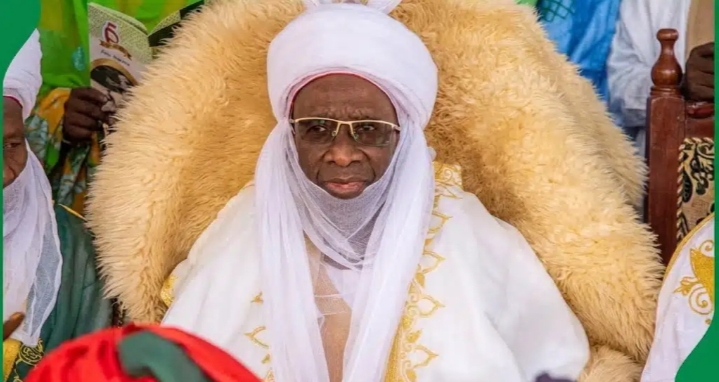
The Emir of Gumel in Jigawa State, Alhaji Dr. Ahmed Muhammad Sani II, CON, has died at the age of 85.
The respected traditional ruler reportedly passed away in Cairo, Egypt, on Thursday, September 3, 2026, bringing an end to a reign that lasted more than four decades. His death has plunged the Gumel Emirate, his family, associates and residents across Jigawa State into mourning.
Former Minister of Communications and Digital Economy, Prof. Isa Ali Pantami, announced the monarch’s death in a condolence message on Thursday. Pantami described the late Emir as a distinguished scholar and a father figure who devoted his life to serving his people, promoting peace and education, and preserving cultural values.
Ahmed Muhammad Sani II became Emir of Gumel in December 1980 following the death of his father. He subsequently presided over the affairs of the historic emirate for more than 45 years, making his reign one of the longest among traditional rulers in northern Nigeria.
His death represents a significant moment for the Gumel Emirate, where the traditional institution remains an important part of community leadership and cultural identity.
Gumel Emirate Mourns
News of the Emir’s death has triggered an outpouring of grief among members of the Gumel community and residents of Jigawa State.
Prayers have been offered for the late monarch, with mourners asking Almighty Allah to forgive his shortcomings and grant him eternal rest in Aljannatul Firdaus.
Prayers have also been offered for his immediate family, relatives, associates, the Gumel Emirate Council and the wider community to receive the strength and patience needed to cope with the loss.
Pantami, in his condolence message, extended his sympathy to the late monarch’s family, the Gumel Emirate Council, the Sultan of Sokoto, the Jigawa State Government and the people of the State. He also prayed for the repose of the Emir’s soul.
The late monarch was widely regarded as the custodian of the traditional institution in Gumel and played a central role in maintaining the customs and values associated with the Emirate.
The Gumel Emirate is one of the historic traditional institutions in northern Nigeria, with a long-standing influence on the social, cultural and community affairs of its people.
A Long Reign Comes To An End
Ahmed Muhammad Sani II ascended the throne in 1980 and remained Emir of Gumel until his death on September 3, 2026.
According to reports, he was born into the ruling family and succeeded his father after the latter’s death in December 1980. His long tenure placed him among Nigeria’s longest-serving traditional rulers.
Before becoming Emir, he received his early education in parts of northern Nigeria, including Gumel, Hadejia and Kano, before proceeding to the Institute of Administration in Zaria, where he obtained qualifications in Public Administration.
Over the decades, his position placed him at the centre of discussions and activities concerning peace, community relations, education, culture and development within the Emirate.
Traditional rulers in northern Nigeria often serve roles extending beyond ceremonial responsibilities, including mediation in community disputes, preservation of cultural heritage and engagement with government and other stakeholders on issues affecting their communities.
The passing of the Emir of Gumel therefore leaves a significant gap in the traditional leadership structure of Jigawa State.
Namadi’s Surprise Secretariat Inspection
The death of the Emir of Gumel comes against the backdrop of other notable developments in Jigawa State, including Governor Umar Namadi’s recent surprise inspection of the State Government secretariat in Dutse.
Namadi conducted the unannounced inspection on Monday, July 20, 2026, arriving at the secretariat at about 11:00 a.m. to assess attendance, punctuality and workplace productivity among Government workers.
The visit reportedly revealed several locked offices belonging to senior Government officials, while many senior civil servants were said to be absent from their duty posts.
A video of the inspection subsequently circulated online, showing the Governor moving through different sections of the secretariat and checking offices. Several workspaces were reportedly deserted, with only a few messengers and security personnel seen around the complex.
Reports identified the offices of the Secretary to the State Government, Head of Service and Accountant-General among those found locked during the inspection. Several commissioners and permanent secretaries were also reportedly absent.
The Governor’s Special Assistant, Garba Muhammad, later confirmed the inspection and said it was part of a wider statewide oversight exercise.
According to Muhammad, the secretariat visit was designed to monitor staff attendance, punctuality and workplace productivity, while also reinforcing the administration’s emphasis on discipline, accountability and efficient public service delivery.
Following the secretariat inspection, Namadi continued his statewide activities, including a visit to Ringim Local Government Area, where he commiserated with families affected by a boat accident at Malamawar ’Yan Dutse community.
He also participated in funeral prayers for recovered victims and visited the Emir of Ringim to offer condolences. The Governor later inspected several infrastructure projects in different parts of the State.
The secretariat incident has renewed attention on the Governor’s efforts to improve discipline and accountability within the Jigawa State public service.
For the Gumel Emirate, however, the immediate focus remains the death of its traditional ruler.
With the passing of Ahmed Muhammad Sani II after more than four decades on the throne, the Emirate has lost a monarch whose reign spanned generations and witnessed significant changes in the social and political landscape of Jigawa State.
As mourners continue to pay tribute, attention is expected to turn to funeral arrangements and the process of selecting a successor to the late Emir of Gumel.